AI From Class 3: What the CBSE Rollout Actually Says
A plain-language guide to India's 2026–27 AI & CT mandate.
AI and Computational Thinking enter Indian classrooms from Class 3 in 2026–27 — no new subject, no separate paper, integrated and assessed. Here's exactly what's required, by when, and what it doesn't demand.
A school principal in Pune asked a straightforward question recently: "What exactly are we required to do, and by when?" She had seen the announcements. She had received a circular. But nobody had put the whole picture in one place, in plain language, without the surrounding noise.
This post is that plain-language guide.
AI is in Indian classrooms from Class 3 — here's what that actually means.
The Policy Foundation: Two Documents You Should Know
The mandate does not come from a single order issued last month. It is the outcome of two connected frameworks that were years in the making.
The first is NEP 2020 — the National Education Policy that set out a wholesale rethinking of school education in India. Among its many provisions, NEP 2020 called for computational thinking and coding to be introduced at the primary level and for school curricula to reflect the realities of a technology-shaped world.
The second is the National Curriculum Framework for School Education (NCF-SE) 2023, released on August 23, 2023. Where NEP 2020 stated the ambition, NCF-SE 2023 is the operational blueprint — specifying curricular areas, learning stages, and the integration of computational thinking across disciplines. Together, these two documents form the constitutional basis for everything CBSE is now implementing.
What CBSE Is Doing, Specifically
In October 2025, CBSE constituted an expert committee — chaired by Professor Karthik Raman of IIT Madras — to develop a curriculum on Artificial Intelligence and Computational Thinking (AI & CT) for students from Classes 3 to 12. That committee's work feeds directly into what CBSE has now officially launched: a structured AI & CT rollout beginning in the 2026-27 academic session.
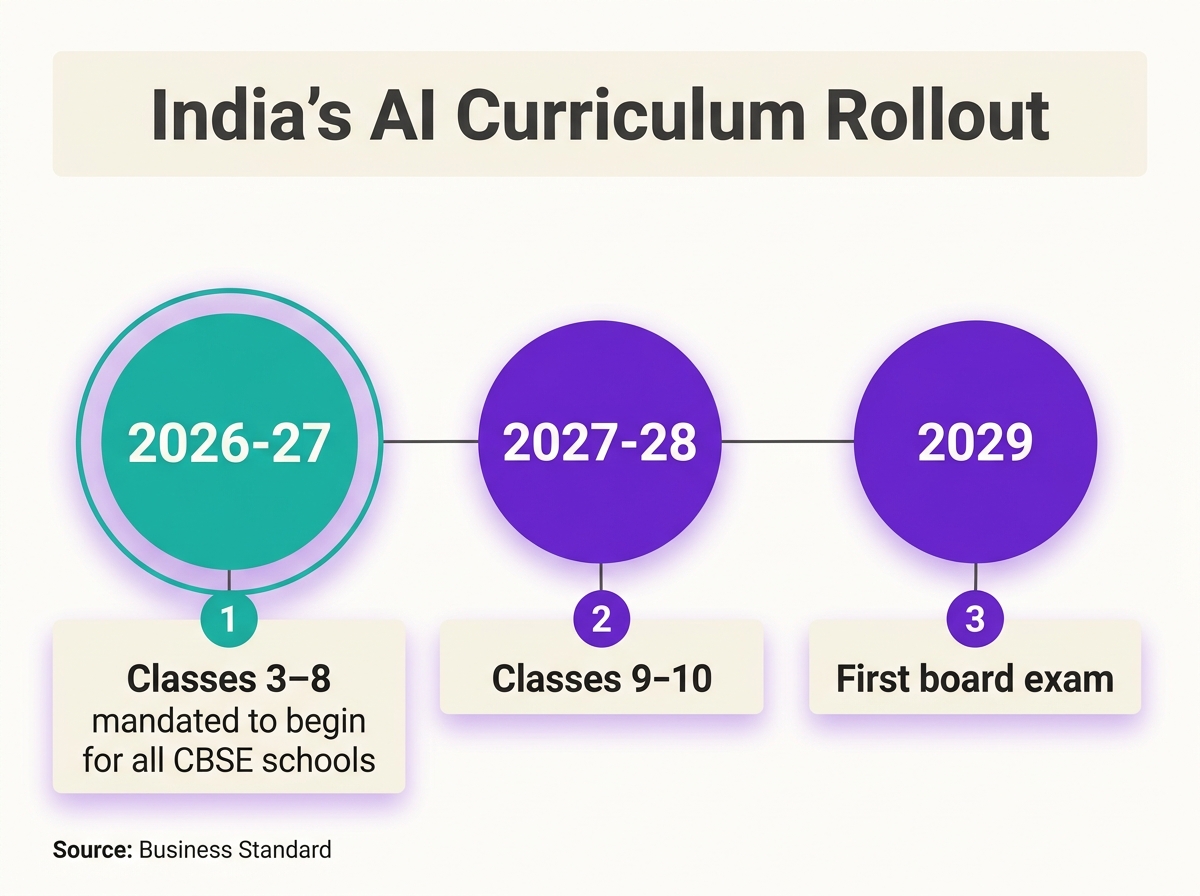
The rollout is phased:
- Classes 3–8, from 2026-27: AI and Computational Thinking is integrated into the existing curriculum and assessed through school-based internal assessment. No new standalone subject. No separate board paper.
- Classes 9–10, from 2027-28: CT and AI becomes a formal compulsory subject, assessed in Annual and Board Examinations.
- First board examination cohort: 2029. That is the year today's Class 6 students reach Class 10.
This phasing matters. If your school is affiliated with CBSE, the clock starts this academic year for Classes 3 through 8.
The "Integrated, Not Standalone" Distinction
This is the point most coverage buries in paragraph seven. For the youngest grades, India is deliberately not creating a new subject called "AI."
For Classes 3 to 5, Computational Thinking is woven into Mathematics and existing subjects. The child doing a sorting activity in Maths is doing CT. Pattern recognition in language lessons counts. Teachers are not expected to pivot to silicon and circuits; they are expected to recognise and articulate the computational thinking that competent teaching already produces, and to add specific new CT elements that their grade-band modules describe.
For Classes 6 to 8, the integration involves cross-disciplinary collaboration — Science, Maths, and Languages working together around AI concepts — still without a separate grade-sheet entry until the transition to secondary school.
This is consistent with how UNESCO's AI Competency Framework for Students approaches foundational AI literacy: it structures competencies so learners develop conceptual understanding before moving to design and creation. It also reflects the AI4K12 initiative's grade-band progression model, which integrates AI concepts into general learning at each stage rather than treating AI as a separate technical subject.
What It Means for Your School Right Now
Three questions principals are asking, answered directly:
Do we need a Computer Science teacher for Classes 3–5? No — and that is the design intent. Mathematics and subject teachers handle CT components at the foundational stage. For Classes 6–8, existing teachers from multiple disciplines collaborate. Computer Science teachers lead only from Class 9 onward.
How will teachers be prepared? The government's primary vehicle is NISHTHA — the National Initiative for School Heads' and Teachers' Holistic Advancement — delivered via the DIKSHA platform. Grade-specific AI modules and video-based learning resources are the delivery mechanism. Teachers handling Classes 3–8 should complete these modules; "CBSE hasn't trained my staff yet" is not an exemption from the 2026-27 start date.
Is this assessed? Yes, with weight. Classes 3–8 students will have AI & CT as part of their formal internal assessment. It carries academic weight. Schools cannot treat it as an enrichment elective or an after-school add-on.
What This Rollout Does Not Cover
Clarity on scope prevents over-engineering. The mandate does not require:
- A dedicated AI lab for Classes 3–5
- Proprietary software from any named vendor
- A separate timetable block at the primary level
- Any AI product endorsed by CBSE over others
The curriculum is framework-level and school-agnostic. How a school chooses to deliver the learning — which tools it uses, what supplementary resources it brings in — is a school-level decision.
Digital Codi is built to align with exactly this type of mandate: a K-6 AI literacy platform designed to align with NEP/CBSE requirements, India's B2C context, and the integrated-subject approach the NCF-SE 2023 recommends. It addresses the Five Capacities — conceptual fluency, mechanical intuition, critical evaluation, ethical reflex, and creative agency — that make AI understanding durable rather than module-deep. For schools evaluating how to operationalise the mandate without inventing a curriculum from scratch, Digital Codi is worth a close look.
The Bigger Picture
NEP 2020 set a direction. NCF-SE 2023 turned that direction into a framework. CBSE's 2026-27 launch translates the framework into a school-year reality. Three documents, three years, one outcome: AI and Computational Thinking is now a formal part of what Indian schools are expected to teach from the earliest years of primary education.
The Beijing Consensus on AI and Education (2019) framed this kind of national-level AI curriculum commitment as a policy imperative for countries that take educational equity seriously. India's rollout — structured across three policy tiers with phased board assessment — is among the more operationally detailed implementations of that principle at scale.
For principals managing the practical side: the question is not whether to comply but how to do so with minimal disruption and maximum learning benefit. The frameworks give you more flexibility than the headlines suggest — and that flexibility is worth understanding before locking in any vendor or approach.
Sources Cited
- Business Standard — CBSE launches AI & CT curriculum for Classes 3–8 — retrieved 2026-05-31
- Press Information Bureau — NCF-SE 2023 release — retrieved 2026-05-31
- DrishtiIAS — Curriculum on AI and CT for Class 3 onwards — retrieved 2026-05-31
- Kashmir Observer — CBSE sets up IIT Madras-led panel — retrieved 2026-05-31
- Sunbeam World School — CBSE New Curriculum 2026-27 — retrieved 2026-05-31
- India's News — Teacher training via NISHTHA — retrieved 2026-05-31
- Ministry of Education — National Education Policy 2020 — retrieved 2026-05-31
- Ministry of Education — NCF-SE 2023 — retrieved 2026-05-31
- UNESCO — AI Competency Framework for Students — retrieved 2026-05-31
- UNESCO — Beijing Consensus on AI and Education (2019) — retrieved 2026-05-31
- AI4K12 Initiative — Artificial Intelligence Thinking in K-12 — retrieved 2026-05-31