
The First Global AI Ethics Standard, Explained
Whose ethics? 193 governments', since 2021.
Add AI ethics to the curriculum and someone asks: whose ethics? Since November 2021 there's an answer — 193 governments adopted the first global standard on AI ethics, and it reaches all the way to your child's classroom.
Picture a school board meeting. Someone proposes adding AI ethics to the curriculum. The first question from the back of the room: "Whose ethics?" It is a fair challenge. Ethics often sounds like opinion — shaped by culture, politics, upbringing. So when teachers or administrators talk about teaching AI ethics in a classroom, the obvious pushback is: who decided what counts?
The answer, since November 2021, is: 193 governments did. Together.
What Actually Happened in November 2021
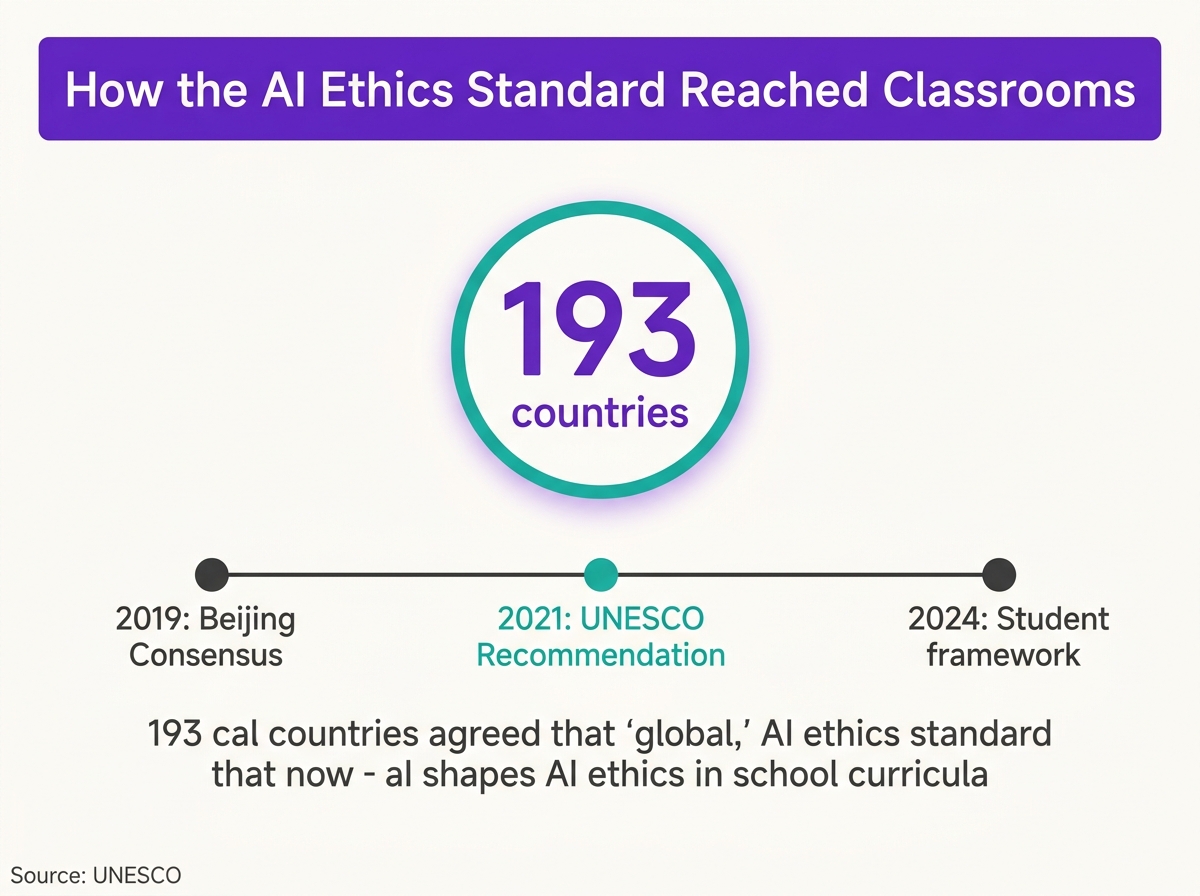
On 23 November 2021, UNESCO's General Conference — all 193 member states — adopted the Recommendation on the Ethics of Artificial Intelligence by acclamation. It is the first global normative standard on AI ethics ever produced. Not a think-tank white paper. Not a corporate pledge. A formal intergovernmental document that every signatory country is expected to implement.
That is worth sitting with. Every country that has a UNESCO membership — which is essentially every country in the world — committed to a shared framework for what ethical AI means and what governments should do about it.
AI ethics isn't an opinion — there's a global standard, and it reaches your kid.
What the Recommendation Actually Says
The document is long. For a parent or school administrator, the useful summary is this: it sets out 10 core principles and 11 policy action areas, all organised around the idea that human rights and human dignity should be the foundation for how AI is built and used.
The 10 principles include proportionality (AI should not do more than necessary), privacy protection throughout the AI lifecycle, human oversight, transparency, and accountability. These are not vague aspirations. They are design requirements — things that AI systems and the institutions deploying them are expected to demonstrate.
The 11 policy action areas are where the document becomes directly relevant to schools. One area is explicitly titled Education and Research. It calls on member states to integrate AI ethics into curricula and support interdisciplinary work on AI's societal impact. That language — "integrate AI ethics into curricula" — is not optional guidance. It is a policy commitment that national education systems, including India's and Canada's, are now building toward.
This matters for anyone asking whether AI ethics belongs in a school. The answer is no longer a matter of local opinion. It is a matter of national policy, grounded in an international standard.
The Pipeline From Geneva to Your Child's Classroom
The cascade works through layers. The Beijing Consensus on Artificial Intelligence and Education, published by UNESCO in 2019, was the first document to translate AI ethics thinking specifically into education settings — calling on governments to develop AI literacy and embed ethical use of technology into teaching. It set the stage for the 2021 Recommendation.
Then, in August 2024, UNESCO published the AI Competency Framework for Students, outlining 12 competencies across four dimensions — one of which is Ethics of AI — designed to guide how countries structure what students learn across three levels: Understand, Apply, and Create. As of 2022, only 15 countries had included AI learning objectives in their national curricula. The framework exists, in part, to close that gap.
The OECD AI Principles, adopted on 22 May 2019, represent the first intergovernmental standard on AI across OECD member nations and were a direct precursor to the UNESCO work. The G20 endorsed them; the EU AI Act drew on them. These are the reference points that ministry officials and school board administrators point to when they need to justify why AI ethics is in a curriculum at all.
India's trajectory follows this pipeline directly. The CBSE and NCERT AI and Computational Thinking curriculum, rolling out from Class 3 onwards and aligned with NEP 2020, explicitly frames ethical and responsible AI use as a core goal — described as "AI for Public Good." The target: implementation by 2026–27. In Canada, provincial guidance documents reference the same UNESCO and OECD anchors when framing digital and AI literacy standards.
Why "Governed Ethics" Changes the Conversation
There is a meaningful difference between a school discussing ethical questions about AI and a school teaching AI ethics as a governed, standardised domain. The first is open-ended discussion. The second has a defined scope — human rights, oversight, accountability, transparency — backed by international agreement.
For parents, this matters because it answers the "whose ethics?" question. The framework your child is being taught is not one teacher's view. It traces back to a document negotiated by 193 governments. That does not make it perfect, but it makes it accountable. There is a structure, and it can be examined.
For school administrators, the argument is cleaner still: AI ethics instruction is not an extra. It is a policy commitment embedded in NEP 2020, NCF-SE, and the CBSE mandate — all of which flow from the same UNESCO source. Teaching it is compliance; not teaching it is a gap.
What a Standards-Aligned Curriculum Looks Like
That matters for how you evaluate what your child's school is actually teaching. Digital Codi's S6 Ethics stream is designed to align with the UNESCO Student Framework, mapping its learning arc to the same four dimensions — including Ethics of AI — that UNESCO uses to organise student competencies. The program's Five Capacities model includes ethical reflex as one of five outcomes, positioned not as a module to complete but as a habit of mind developed across the full curriculum. That design choice reflects the standard's direction: ethics is not a chapter at the end. It is a lens applied throughout.
For administrators evaluating AI literacy programs, that alignment is a practical compliance anchor. For parents, it is reassurance: the questions your child is being asked to think about — about fairness, accountability, and what AI should and should not do — are the same questions 193 governments agreed to make central to how AI is governed.
The standard exists. It reached the classroom. Now it is a matter of whether the curriculum takes it seriously.
Sources Cited
- UNESCO Recommendation on the Ethics of Artificial Intelligence — retrieved 2026-05-31
- UNESCO Ethics of AI — full framework page — retrieved 2026-05-31
- UNESCO AI Competency Framework for Students — retrieved 2026-05-31
- Beijing Consensus on Artificial Intelligence and Education — retrieved 2026-05-31
- OECD AI Principles — retrieved 2026-05-31
- CBSE/NCERT AI and Computational Thinking Curriculum 2026–27 — retrieved 2026-05-31