
Dinner. A Tuesday. Your nine-year-old looks up from their plate and asks: “Could a robot do your job?”
You pause. You've read the headlines — ChatGPT writing essays, deepfakes in elections, entire departments replaced by automation. You know AI is a big deal. You know your child should probably understand it. But you can't explain it to them — because nobody ever explained it to you.
You're not alone. Most parents believe AI will significantly impact their child's future, but fewer than one in five can name a single AI concept they'd want their child to learn. The gap isn't about intelligence or effort. It's about not having a map.
This post is that map.
You don't need a technical background. You need five minutes, seven questions, and the willingness to discover — alongside your child — where their AI literacy stands right now.
Here's the good news: AI literacy isn't one enormous thing you've been neglecting. It's seven manageable areas. And your child is probably already further along than you think.
What AI Literacy Actually Is (And Isn't)
AI literacy is not learning to code. It's not robotics club. It's not memorising how ChatGPT works.
AI literacy is the ability to understand, use, question, and think critically about AI systems — the same systems your child interacts with every single day, from voice assistants to recommendation feeds to the filters on their favourite app.
Think of it like media literacy. A decade ago, we realised kids needed to understand how news, advertising, and social media worked — not so they could become journalists, but so they could navigate the world with their eyes open. AI literacy is the same shift, happening right now. Your child doesn't need to build AI systems to understand how they shape daily life.
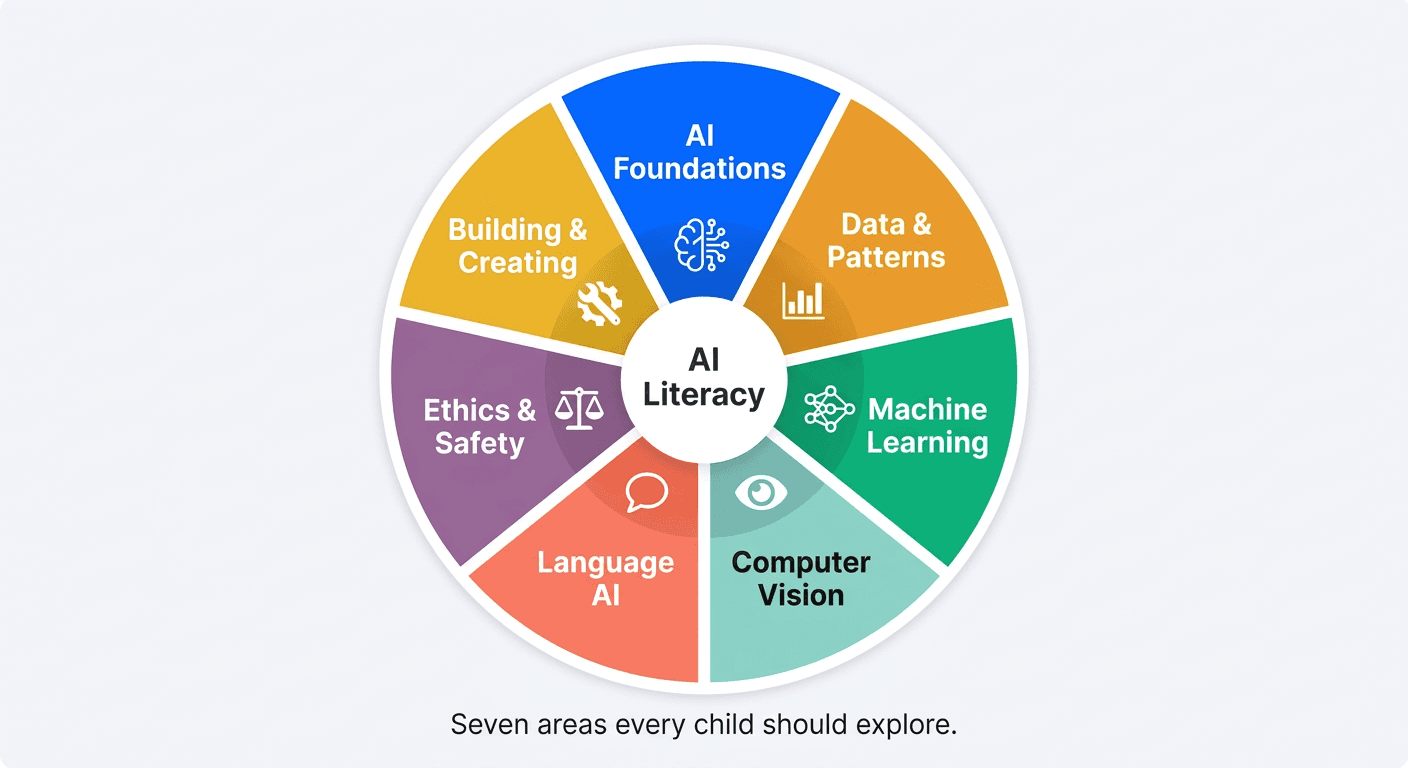
The difference? AI literacy has a clearer structure than most parents realise. It breaks down into seven distinct domains — seven areas of knowledge that, together, give a child a complete foundation for understanding artificial intelligence.
The 7-Question Readiness Check
Here's the simplest way to understand those seven domains: ask your child these seven questions. You don't need to quiz them formally — bring one up at dinner, in the car, or during a walk. Their answers (or their silence) will tell you exactly where they stand.
AI Foundations — understanding what AI actually is
"What's the difference between something that's smart and something that's just following instructions?"
A calculator follows instructions. A voice assistant recognises speech, interprets meaning, and generates a response. The difference between automation and intelligence is the bedrock of AI literacy. If your child can explain — even loosely — that AI learns from examples rather than following a fixed recipe, they've grasped the foundation.
Data & Pattern Discovery — how AI uses information
"How does YouTube know what to recommend next?"
Every recommendation, every 'you might also like,' every targeted ad is built on data — patterns extracted from millions of individual choices. If your child understands that their viewing history, clicks, and watch time feed an algorithm that predicts what they'll enjoy, they're already thinking about data patterns. This domain is about understanding that data is the raw material of all AI.
Machine Learning — how AI models learn
"If you wanted to teach a computer to tell cats from dogs, how would you do it?"
This question opens the door to the most important concept in modern AI: learning from examples. A strong answer doesn't require technical language. 'Show it lots of pictures of cats and lots of pictures of dogs' is exactly right. That's supervised learning, explained in one sentence.
Computer Vision — how AI processes images
"How does your phone know which face is yours?"
Face unlock, photo tagging, augmented reality filters — your child uses computer vision daily. This domain covers how machines interpret visual information: pixels, patterns, shapes, and recognition. A child who can say 'it remembers what my face looks like' is on the right track.
Language AI — how AI processes words and speech
"How does Alexa understand what you're saying?"
From voice assistants to chatbots to translation apps, language AI is woven into daily life. If your child understands that Alexa doesn't 'hear' the way humans do — that it converts sound into data, breaks it into pieces, and matches those pieces against learned patterns — they've started thinking about natural language processing, one of the fastest-moving areas in all of AI.
AI Ethics & Safety — fairness, bias, and responsibility
"Is it fair for AI to decide who gets into a school or who gets a job?"
This is the question that has no clean answer — and that's the point. AI ethics is about recognising that AI systems reflect the biases in their training data, that privacy matters, and that just because a machine can make a decision doesn't mean it should. If your child hesitates before answering, good. That hesitation is critical thinking in action.
Applied AI — moving from understanding to building
"If you could build an AI to solve one problem in your life, what would it be?"
This is the creative domain. It's the leap from understanding AI to imagining what you'd build with it. A child who can name a problem and sketch a rough idea — 'an AI that helps me find my lost things' or 'an AI that makes homework go faster' — is thinking like a builder, not just a consumer.
Reading Your Results
If your child answered zero to two of these confidently, they're exactly where most kids are. AI isn't taught systematically in most schools. The gap is completely normal, and closing it is easier than you think.
If they answered three to five with real understanding, they've absorbed more than you might expect — likely from daily interactions with technology. What they need now is structured learning that turns intuition into knowledge.
If they handled six or seven with nuance, you may have a genuinely AI-curious child on your hands — one who would thrive with deeper exploration, real projects, and progressive challenges.
Key Point
The point of this exercise isn't to score your child. It's to make the invisible visible. Each question your child couldn't answer isn't a deficiency. It's a door. And now you know exactly which doors to open first.
Your Weekend Starting Point: The Sorting Game
You now have a map. Here's your first step on it.
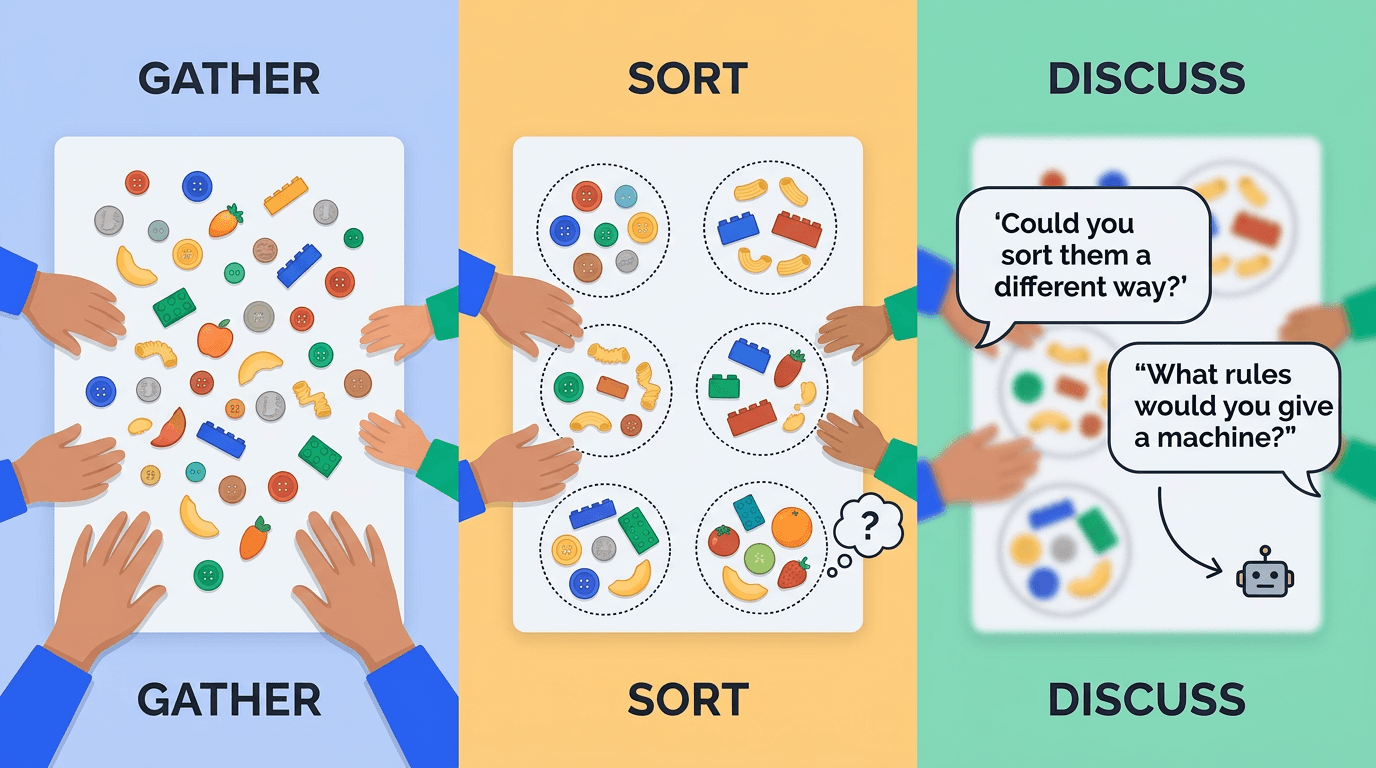
This weekend, try the Sorting Game — a fifteen-minute activity that introduces classification, the single concept that underpins nearly every AI system in existence. No devices required. No tech background needed.
Gather
Collect 20–30 small household items: buttons, coins, LEGO bricks, pasta shapes, socks, fruit — whatever is handy.
Sort
Ask your child to sort them into groups. Don't tell them how — let them choose their own categories. Colour? Size? Shape? Function? There's no wrong answer.
Discuss
Once they've sorted, ask: “Why did you put these together?” Then: “Could you sort them a different way?” And finally: “If a machine had to sort these, what rules would you give it?”
That final question is the bridge. Your child just experienced the core challenge of AI: turning human judgment into rules a machine can follow. When they realise that different rules produce different groupings — and that the “right” grouping depends on what you're trying to achieve — they've touched the foundations of machine learning, data science, and even AI ethics in a single fifteen-minute activity.
Fun Fact
You didn't need a computer science degree. You needed a handful of buttons and a good question.
Seven Doors, One Starting Point
AI literacy isn't a single skill to acquire or a single class to take. It's seven areas of understanding that, together, give your child the ability to navigate — and eventually shape — a world increasingly powered by artificial intelligence.
You now know what those seven areas are. You know which ones your child has started to explore and which ones are still waiting. And you have a concrete first activity to try this weekend.
If you want to take the next step, Digital Codi organises these seven domains into age-appropriate learning adventures — complete with stories, quizzes, and hands-on projects matched to your child's developmental stage, from ages 6 through 14. It's structured AI education that feels like a game, not a lecture.
The rest is just opening doors.
Ready to Open Those Doors?
Start your child's AI literacy journey today — seven domains, one adventure at a time.
Start Free Trial →