The Tale of Two Ten-Year-Olds
Same age, same city, two relationships with the machine.
Arjun and Priya are both ten, in the same city, the same income bracket — and both use AI every day. Only one of them is learning anything. The difference isn't money or school; it's a habit that forms in the ten minutes after homework.

Arjun and Priya are both ten. They live in the same city — different neighbourhoods, similar schools, similar household incomes. Neither family is wealthy. Neither is struggling.
Both children use AI tools every day.
That is where the similarity ends.
When Arjun gets a school project on water scarcity, he opens an AI assistant and types the whole question in. A paragraph appears. He reads it quickly, copies a few lines, and moves on. The tool did the thinking. He didn't need to.
When Priya gets the same project, something different happens. Her mother — curious about this whole AI business — started asking Priya small questions about it six months ago. Not lessons. Questions. What did you ask it? Did it get anything wrong? What would happen if you asked it differently? Priya now types a different first message. She asks the assistant to explain the concept first, then lists three things she already knows, then asks the tool to challenge her understanding. She gets a tool's output, examines it critically, and builds her own argument from the pieces.
Both children finished the project. Only one of them learned anything.
Same age. Same city. Two completely different relationships with the machine.
The gap between Arjun and Priya is not about intelligence. It is not about money — they are in the same bracket. It is not even, in the strictest sense, about school. Both schools have the same computer lab.
The gap is about exposure and habit.
Priya's mother did not enrol her in a coding academy or buy expensive software. She did one thing: she got curious alongside her daughter, and she introduced a simple habit of questioning what the tool produces rather than simply accepting it.
Arjun is not failing. His grades are fine. What is invisible — and this is the uncomfortable part — is that Arjun is being quietly shaped by the tool while Priya is quietly shaping it. Month by month, that difference compounds.
Researchers and policymakers have begun to formalise exactly this concern. The UNESCO AI Competency Framework for Students organises what students need to develop across four dimensions — one of which is a "human-centred mindset" that asks learners to understand and assert their agency when they encounter AI, not simply defer to it. The framework was built precisely because passive, uncritical consumption of AI output is a predictable default that has to be countered deliberately.
In India, the pattern is now embedded in policy: CBSE has mandated AI and computational thinking as integrated subjects from Class 3 onwards, starting from the 2026-27 academic year, in line with NEP 2020. The mandate is a formal acknowledgement that waiting until secondary school is too late. The habits form earlier.
The AI4K12 initiative, which organises K-12 AI education around grade-band progressions, makes the same point structurally: the foundations for reasoning about AI systems — Perception, Representation and Reasoning, Learning, Natural Interaction, and Societal Impact — are meant to begin in the K-2 and 3-5 bands, not in high school. By the time a child is ten, the window for forming foundational habits is already well underway.
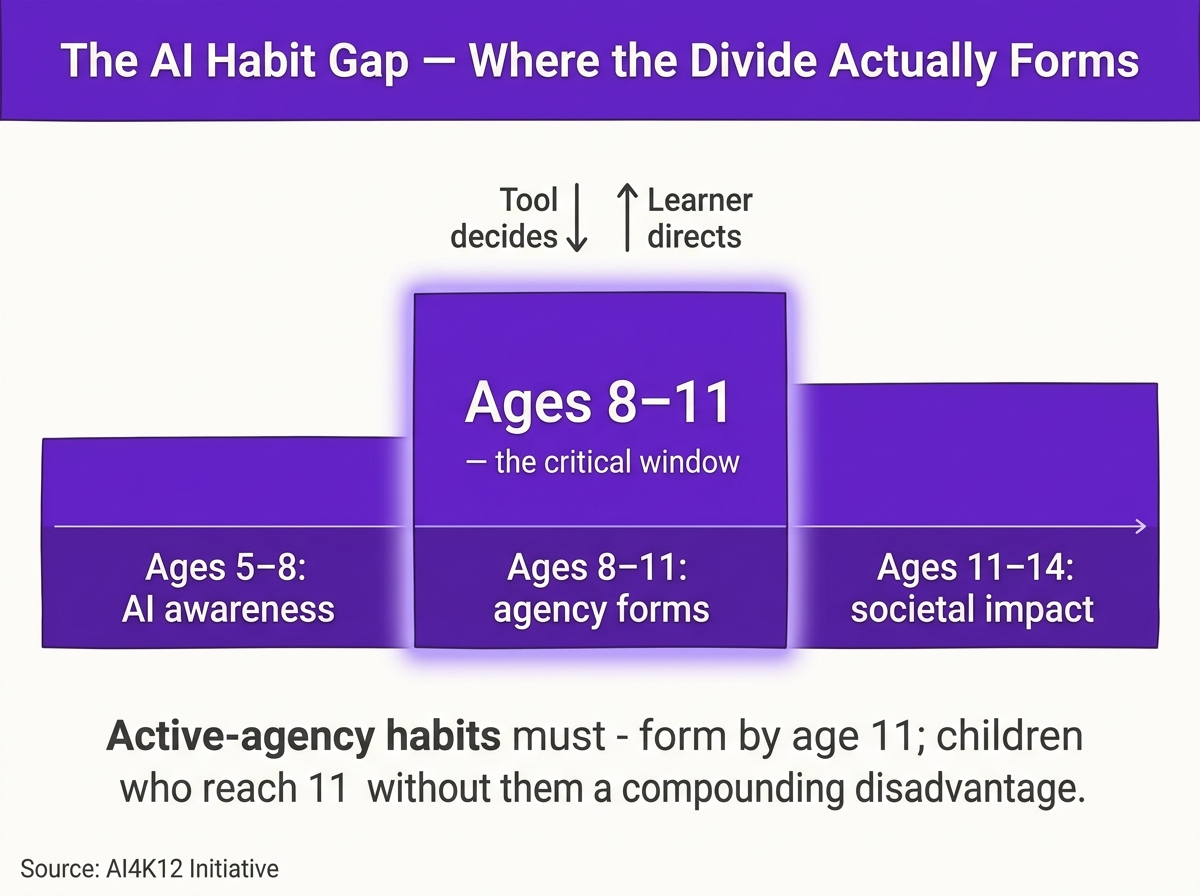
All of this is background context for a much simpler observation: the divide forming right now is not between schools. It is forming inside homes, in the ten minutes after homework is finished.
Here is the part that matters most: this divide is not permanent.
Arjun is not trapped. His trajectory is not fixed. The habits Priya has developed in six months can be developed in six months. The difference is not a gap that closes with money or tutoring hours — it closes with a different kind of attention.
The question to ask is not "is my child using AI?" Almost certainly they are. The question is: are they commanding it, or being commanded by it?
That is a question most parents haven't thought to ask yet — not because they don't care, but because no one framed it this way. The AI tools arrived, the children started using them, and the path of least resistance was to let it happen.
The habits that form in these early years are durable. They do not have to be the wrong ones.
Programs like Digital Codi are designed around exactly this distinction — the difference between a tool that a child uses and a tool that uses a child. Its curriculum for 8-to-12-year-olds is built on the idea that AI should function as a sparring partner, not a crutch: a system that pushes back, asks follow-up questions, and develops the same capacity for critical engagement that Priya's mother sparked with a few curious questions after school.
The goal is not to produce AI engineers. It is to produce ten-year-olds who are on the right side of that divide — the side that still holds the pen.
Sources Cited
- UNESCO AI Competency Framework for Students — retrieved 2026-05-31
- CBSE Notification: Computational Thinking and AI Curriculum from 2026-27 — retrieved 2026-05-31
- AI4K12 Grade Band Progression Charts — retrieved 2026-05-31