The Three Ways Machines Learn
Flashcards, button-sorting, and video games.
A child with flashcards, a toddler sorting buttons, a first-timer mashing a game controller. Those three scenes are, almost literally, the three ways machines learn — supervised, unsupervised, and reinforcement.
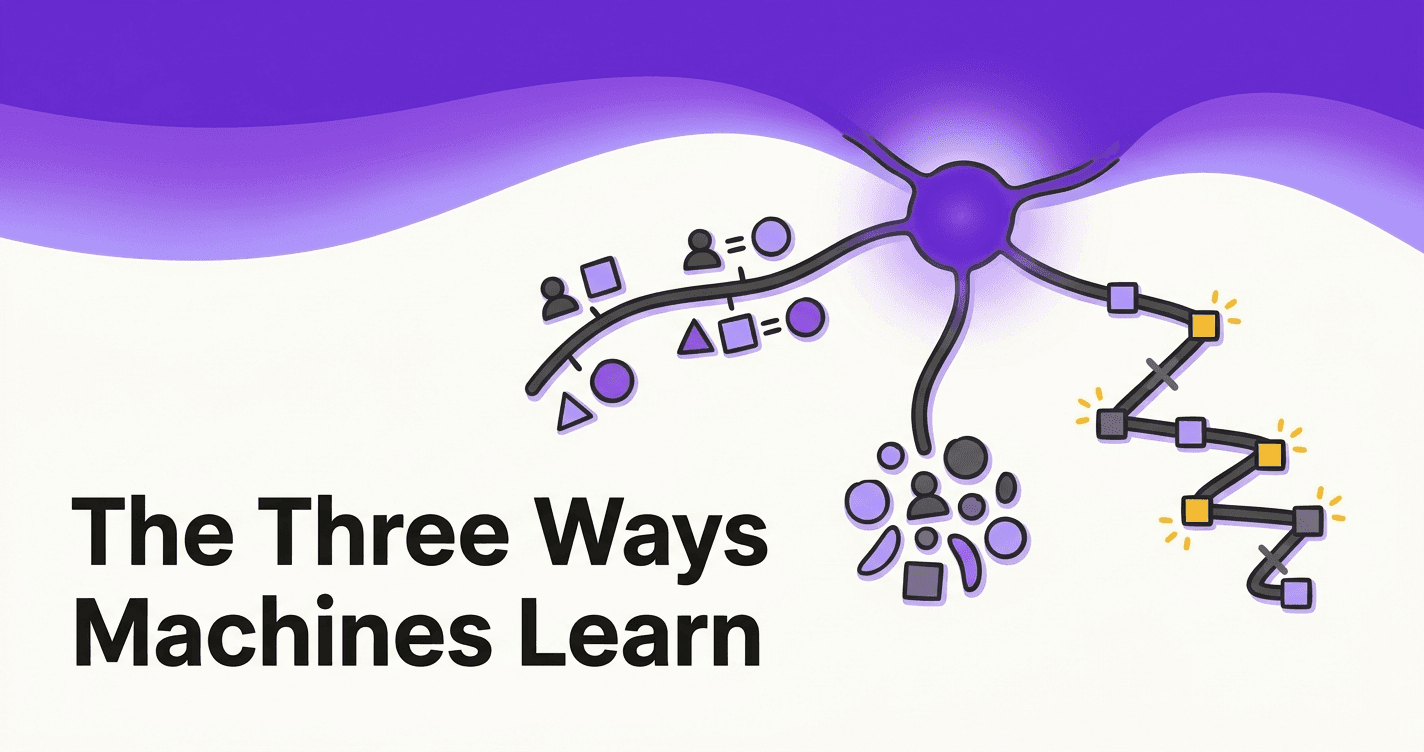
Picture three scenes from ordinary life.
In the first, a parent holds up a flashcard with a picture of a dog and says, "Dog." They hold up a cat. "Cat." After a hundred cards, the child can identify new animals they've never seen before. They learned by example — labeled, corrected, repeated.
In the second, a toddler empties a pile of mixed buttons onto the floor and quietly starts sorting them by color, then by size, then by a logic only they can explain. Nobody told them what the groups should be. They found the structure themselves.
In the third, someone plays a video game for the first time. No instruction manual. They press buttons, die constantly, collect points when something goes right, lose points when something goes wrong, and over a few hours they get surprisingly good. Trial, error, reward, repeat.
Those three scenes are not metaphors for childhood. They are, almost literally, the three ways machines learn.
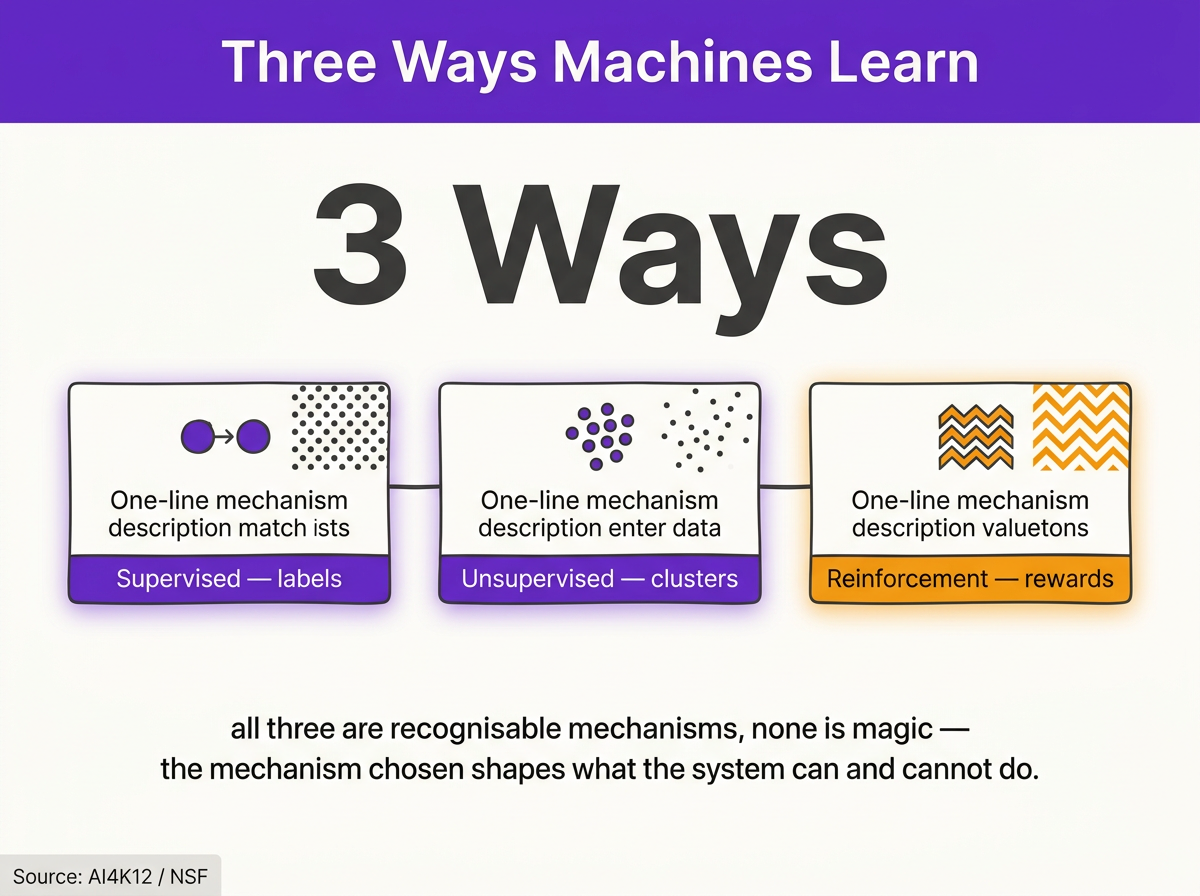
Three ways machines learn — and none of them is magic.
Learning Type 1: Supervised Learning
Supervised learning is the flashcard method. An algorithm is shown thousands — sometimes millions — of examples, each one already labeled with the correct answer. A spam filter trained this way has seen millions of emails tagged "spam" or "not spam." A photo-labeling system has seen millions of images tagged with what they contain. The algorithm learns the pattern connecting input to label, and then applies that pattern to new data it has never seen.
The word "supervised" simply means that a human prepared the labeled examples in advance. Someone had to tag all those spam emails. Someone had to annotate all those photos. The supervision is human, up front, in the data.
Most of the AI your family encounters every day — photo recognition, voice assistants that understand commands, recommendation engines on streaming platforms — runs on supervised learning.
Learning Type 2: Unsupervised Learning
Unsupervised learning is the button-sorting method. The algorithm receives data with no labels at all. Its job is to discover structure that wasn't explicitly given. It groups similar things together, spots unusual outliers, or compresses complex data down to its essential patterns.
Where does this appear in real life? When a music app notices that you listen to a lot of slow piano music on Sunday mornings and starts clustering your listening behavior with others who share that pattern — without anyone ever defining "slow Sunday listener" as a category — that is unsupervised learning at work. The categories emerged from the data.
This type is less visible to end users precisely because it rarely produces a labeled output you can point at. It works backstage, organizing data so other systems can use it more efficiently.
Learning Type 3: Reinforcement Learning
Reinforcement learning is the video-game method. An agent — a piece of software — takes actions in an environment and receives a reward signal when those actions lead toward a goal, and a penalty when they don't. There is no labeled dataset. There is no pre-given structure. The agent figures out what works by doing things and observing what happens.
This is how AI systems learned to play chess, Go, and many video games at superhuman levels. It is also how robots are trained to walk, and how some recommendation systems are tuned to maximize engagement. The agent is not told what the right move is. It discovers the right move by trying wrong ones first.
A parent watching reinforcement learning in action would recognize the loop immediately. It is, stripped of the technical scaffolding, how most physical skills are learned: consequence, adjustment, repetition.
Why the Distinction Matters for Your Child
These are not just vocabulary terms. Understanding which type of learning is at work changes how you read an AI system's behavior.
A supervised system is only as good as the labels it was trained on. If those labels reflect historical biases — hiring patterns, criminal sentencing records, medical diagnoses that skewed toward certain demographics — the system will reproduce those biases faithfully. That is not a glitch. That is the system doing exactly what it was built to do.
An unsupervised system will find patterns, but it cannot tell you whether those patterns are meaningful or coincidental. Grouping is not the same as understanding.
A reinforcement learning system will optimize relentlessly toward whatever reward signal it was given. If that signal is poorly designed — "maximize clicks" rather than "maximize accurate information" — the system will find the shortest path to clicks, which is not the same as the most useful path.
Knowing the mechanism is not the same as being able to build the mechanism. But it is the difference between treating AI as a black box and treating it as a tool with a knowable design. That shift in framing — from magic to mechanism — is exactly what literacy looks like.
The AI4K12 initiative, a national US effort to develop K-12 AI education guidelines, places this three-way distinction inside its core "Learning" big idea — one of five foundational concepts every student should grasp before finishing school. The UNESCO AI Competency Framework for Students echoes this directly, identifying supervised, unsupervised, and reinforcement learning as age-appropriate knowledge for school-aged learners. Canada's Digital Moment AI Literacy Framework for elementary and secondary education similarly anchors AI techniques and applications — including machine learning — as core data literacy.
These are not fringe academic positions. They reflect an emerging global consensus that mechanical intuition about AI is a basic literacy skill.
The Role of Digital Codi
Digital Codi (also called AIGo), a K-6 AI literacy platform, builds its Machine Learning stream around exactly this arc. The curriculum is designed to develop what it calls mechanical intuition — one of its five core learning capacities — so that children aged 8–12 build a working, not just decorative, understanding of how AI learns before they encounter it as adults in consequential settings. Digital Codi's approach is aligned with the Canada national framework, UNESCO Student Framework, and AI4K12 guidelines. The three-type framework here serves as the cornerstone of that stream; each type gets its own dedicated treatment in subsequent posts.
The goal is not to produce junior engineers. It is to produce people who, when an AI system behaves in an unexpected way, have a reasonable first question: which learning mechanism is behind this, and what was it optimized for?
That is a question worth being able to ask.
Sources Cited
- AI4K12 / NSF — Machine Learning and the Five Big Ideas in AI — retrieved 2026-05-31
- UNESCO AI competency framework for students — retrieved 2026-05-31
- Digital Moment — AI Literacy Framework for Elementary and Secondary Education — retrieved 2026-05-31