What Does AI Actually Mean? A Parent's No-Jargon Guide
Five Things Your Child's Teacher Can't Correct
Your child has already decided what AI is — and they're wrong in ways that will cost them. Five myths, five corrections, five sentences you can say at dinner tonight.
Your child has already decided what AI is.
They decided without your help. Not from a lesson plan, not from a textbook, and not from you. They decided from autocomplete finishing their sentences. From TikTok knowing what they wanted before they did. From asking ChatGPT to explain something their teacher couldn't — and getting an answer that sounded perfect.
They've built a mental model of AI. It's confident. It's detailed. And it's wrong in ways that will cost them — not next decade, but now. The problem isn't that your child is curious about AI. The problem is that the answers they've absorbed are wrong, and nobody in their life is correcting them.
Not their friends. Not their teacher. Definitely not the apps they use twelve hours a day.
Five myths. Five corrections. Five sentences you can say at dinner tonight.
Here's the thing most parents miss: understanding AI isn't about learning how the technology works. It's about unlearning what your child already believes. Because right now, your child is carrying five beliefs about AI that sound reasonable, feel true, and are quietly making them worse at thinking — not better.
Their teacher can't see these beliefs forming. They form on the couch, in the group chat, under the covers at 10 pm with a screen glowing. No curriculum covers them. No classroom catches them.
Myth 1: "AI Is Always Right"
This is the one that does real damage.
Your child treats AI output the way they treat a calculator — as fact. They type a question, they get an answer, they move on. It doesn't occur to them that the answer might be wrong, because nothing in their experience has taught them that a machine can sound certain and still be lying.
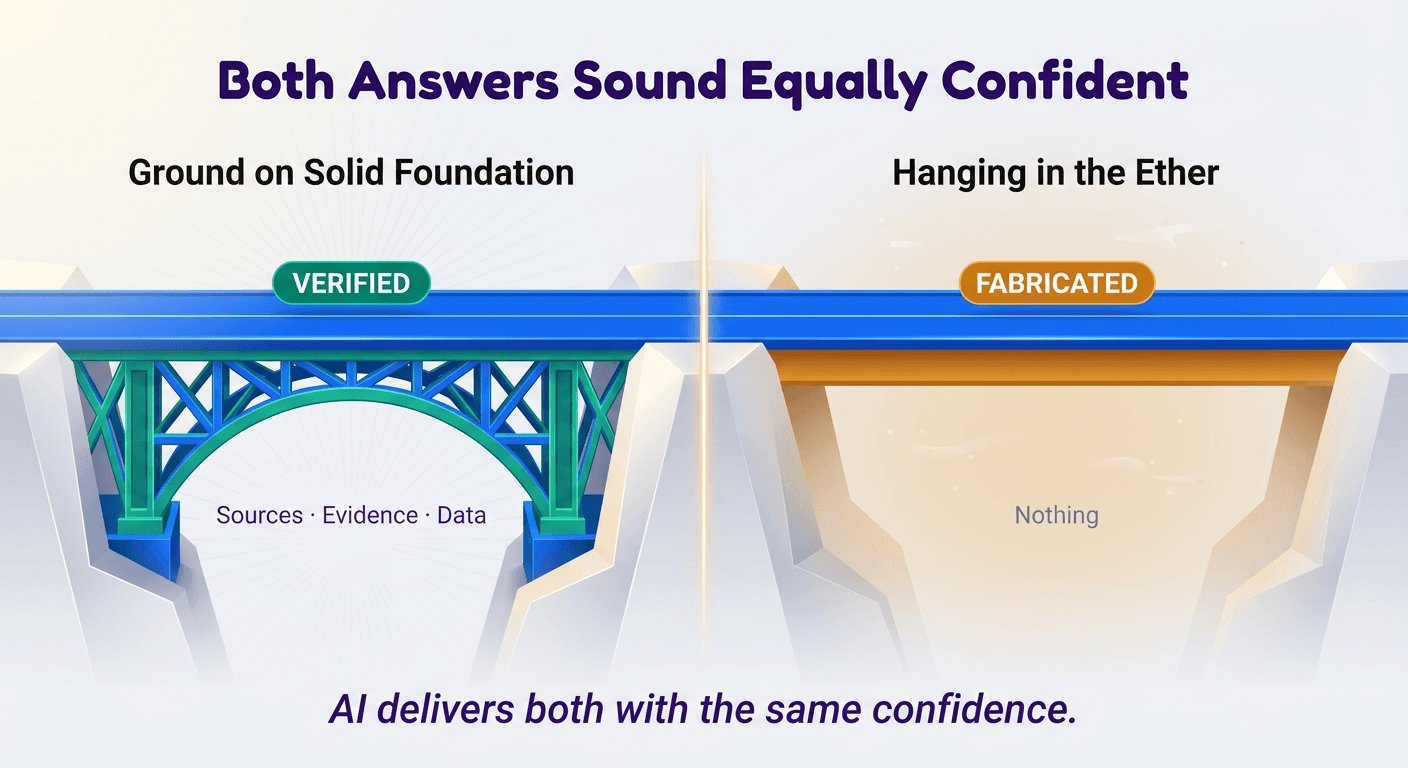
But AI does lie. Constantly. It's called hallucination, and it's not a rare glitch — it's a feature of how these systems work. AI doesn't look things up the way your child looks something up in a book. It doesn't consult a database of verified facts. It predicts the most likely next word, over and over, until it's built something that sounds like a real answer. Sometimes that answer is accurate. Sometimes it's completely invented — a fake source, a made-up date, a statistic that never existed. And AI delivers both with the exact same confidence, the exact same formatting, the exact same tone.
A misspelled word from autocorrect is funny. A fabricated date in a history assignment is not. A made-up statistic in a science project is worse. And your child has no reason to question any of it — because the tone never wavers. The voice never hesitates. The answer always sounds right, even when it's completely invented.
The skill your child is missing isn't technical. It's suspicion.
Tell your kid: "AI sounds sure even when it's completely wrong — your job is to catch it, not believe it."
Myth 2: "AI Knows Me"
Your child thinks the algorithm understands them. And why wouldn't they? It recommended their favourite song before they searched for it. It served them the exact video they didn't know they wanted. It finished their sentence more accurately than their best friend could.
To a child, that feels like being known. Being seen. Being understood by something that pays attention when everyone else is busy.
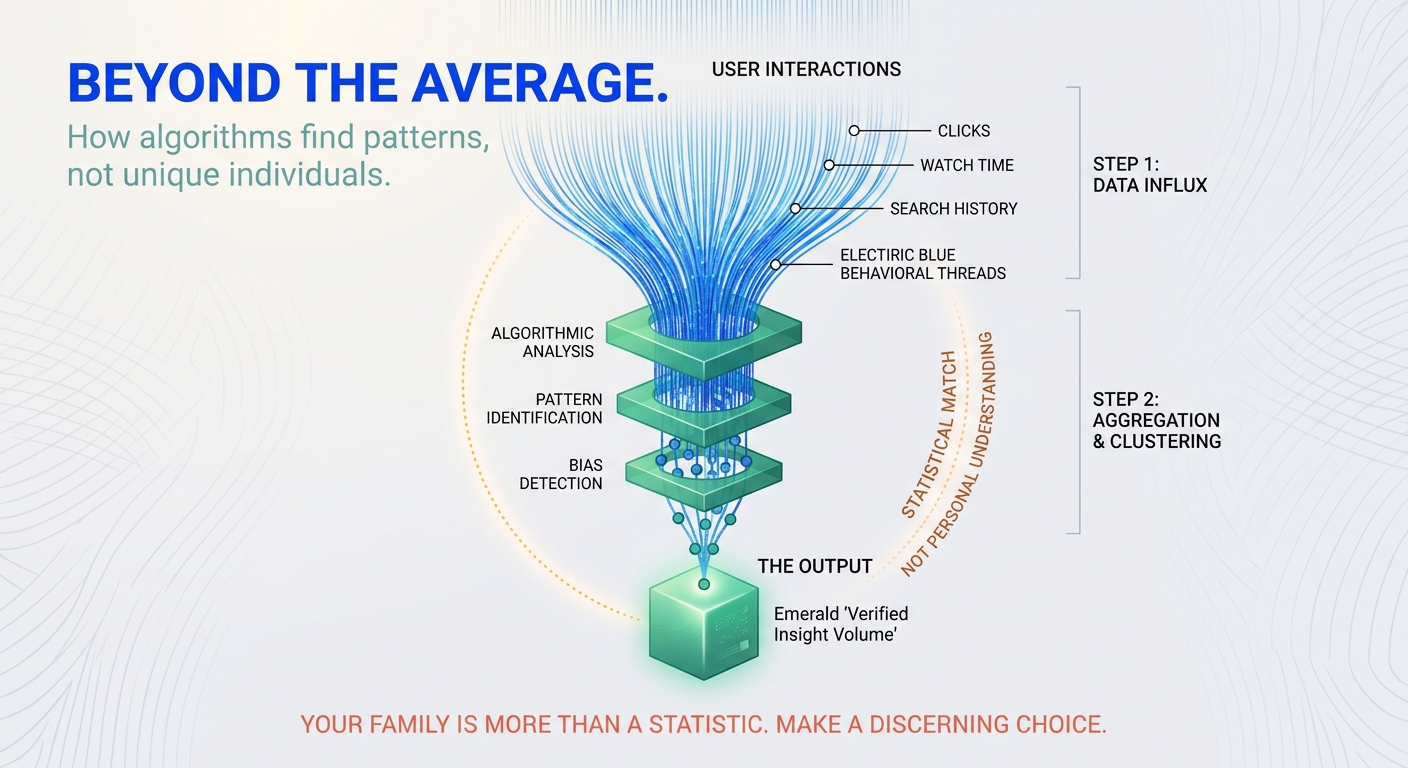
It isn't any of those things. It's pattern-matching against millions of other users who tapped, swiped, and clicked in similar sequences. The algorithm doesn't know your child. It knows what people shaped like your child's data profile usually do next — and it's betting they'll do the same.
But that feeling — it gets me — builds a trust that no teacher can see forming and no classroom can address. No teacher watches your child's feed. No teacher sees the moment your child stops choosing content and starts passively accepting whatever the algorithm serves. No teacher notices when curiosity gets replaced by consumption, or when "I want to watch this" becomes "this is what appeared."
That surrender happens privately. And it looks like contentment.
Tell your kid: "AI doesn't know you. It knows what people like you usually click — and it's betting you'll do the same thing."
Myth 3: "AI Is Fair"
Children assume AI is neutral the way they assume a coin flip is neutral. The machine doesn't have feelings, so it must be objective. It doesn't have opinions, so it must be fair. This logic feels airtight — and it's completely wrong.
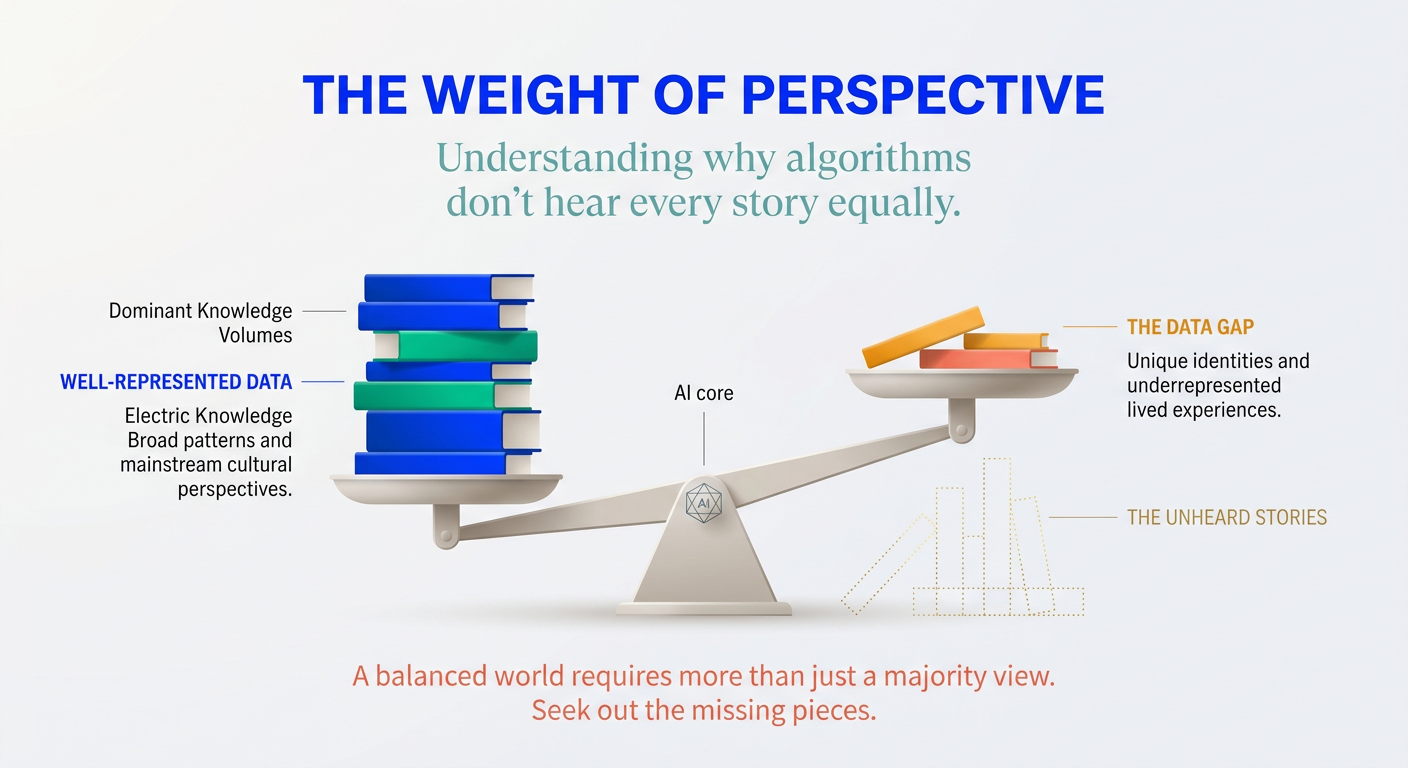
AI learns from human data. Human data is a record of human behaviour. And human behaviour is full of bias — racial, economic, geographic, linguistic. When a hiring algorithm penalises résumés from certain neighbourhoods, it's not being malicious. It's repeating the patterns it learned from decades of biased human decisions. When a facial recognition system works better on lighter skin tones, it's not broken. It was trained on data sets that underrepresented darker skin tones. The system is doing exactly what it was designed to do — and that's the problem.
A child who believes AI is impartial will never think to ask who built it. Who chose the training data. Whose experience is represented — and whose is missing. Those aren't computer science questions. They're citizenship questions. They're the kind of questions that determine whether your child grows up to be a thoughtful participant in an AI-shaped society, or a passive one.
And no one in your child's school is teaching this — because it isn't in any curriculum, and most teachers don't know the answer themselves.
Tell your kid: "AI learns from people — and people aren't always fair. So AI isn't always fair either, unless someone checks."
Myth 4: "If AI Helped Me, It's Still My Work"
This belief is forming right now, in real time, in your child's homework.
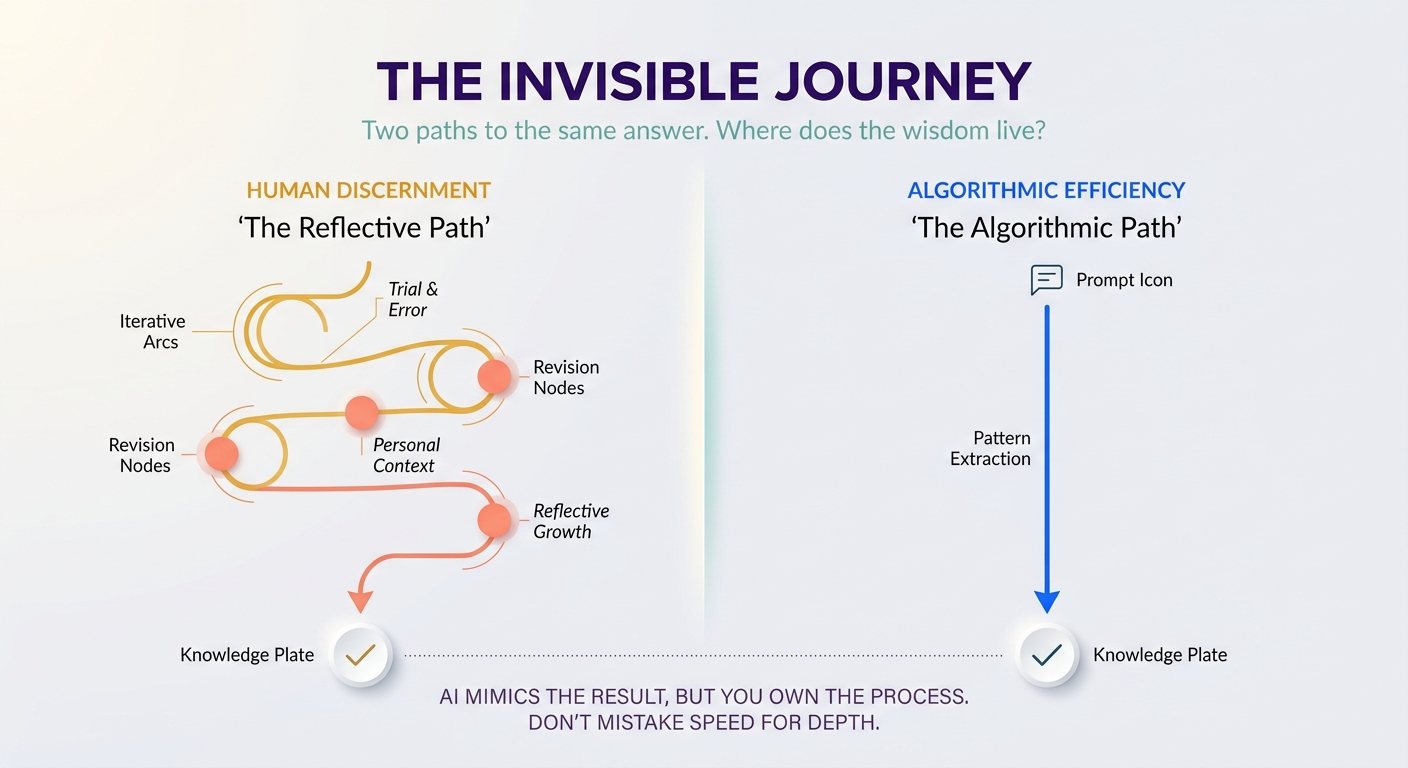
They're not plagiarising — at least, they don't think they are. They asked the AI a question. They read the answer. They agreed with it. They pasted it in and changed a few words. In their mind, they engaged with the material. They made a judgment call. They put it in their own document. That's their work.
But something crucial got skipped. The struggle. The part where you stare at a blank page and don't know what to say. The part where you write a bad sentence, realise it's bad, delete it, and try again. The part where the idea takes shape slowly, painfully, through the friction of your own thinking. That's not the annoying part of learning. That is learning.
Teachers can detect copied text. Plagiarism checkers can flag suspicious passages. But nobody can detect a child who has stopped struggling with ideas because a machine struggles for them. Nobody catches the moment a child's relationship with difficulty shifts from "I need to push through this" to "I'll just ask the AI." That moment is invisible. And it's happening in kitchens and bedrooms across the country every single evening.
The danger isn't cheating. The danger is a child who never learns what their own thinking feels like — and therefore can't tell the difference between an idea they had and an idea they borrowed.
Tell your kid: "If you can't explain it without AI open in front of you, you didn't learn it — AI did."
Myth 5: "I Don't Need to Understand AI — I Just Need to Use It"
This is the myth that sounds the most reasonable. Adults say it too. Use the tool, get the result, move on. You don't need to understand how your car engine works to drive to the grocery store. Why should AI be any different?
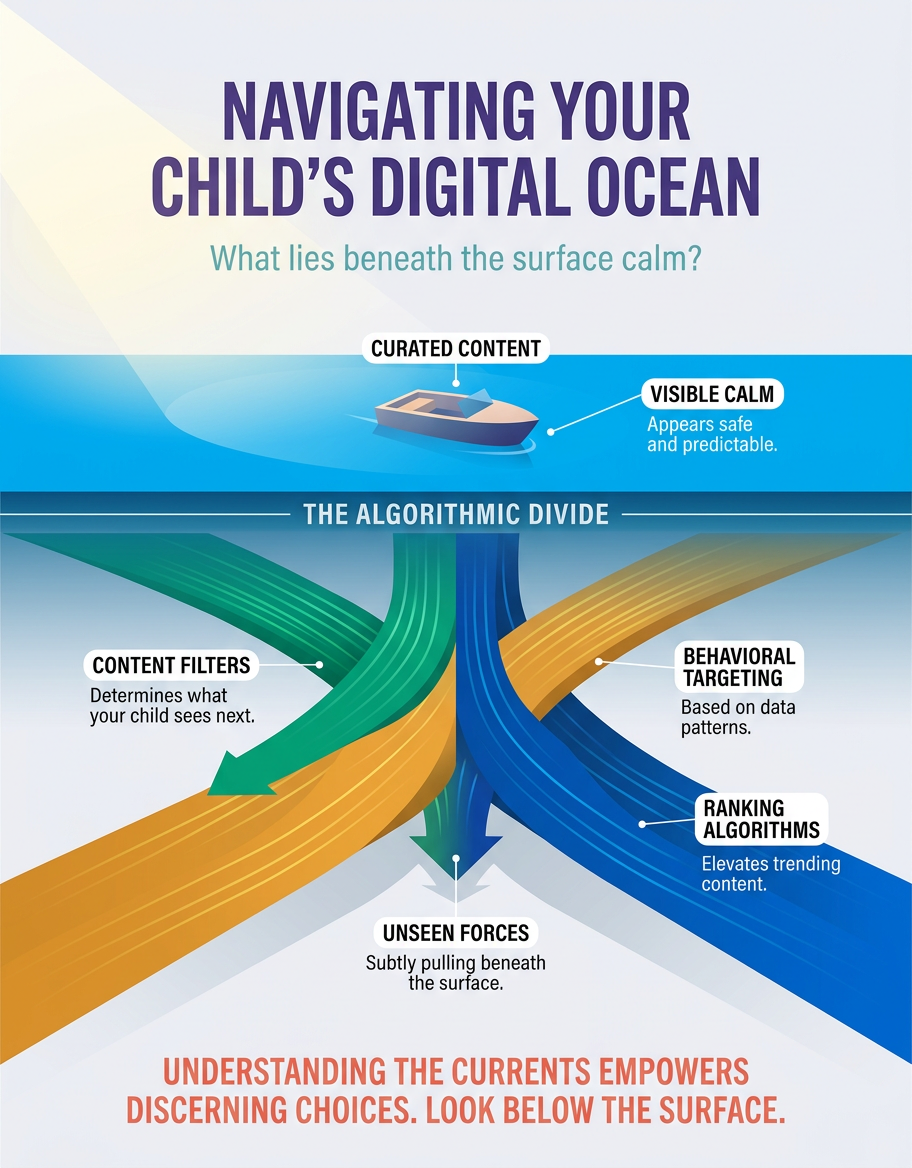
Because you don't live inside your car engine. Your child lives inside AI systems. They wake up to an AI-curated alarm playlist. They scroll an AI-curated feed over breakfast. They get AI-curated search results for homework, AI-curated suggestions for what to watch, AI-curated friend recommendations. Every piece of information that reaches your child has been filtered, ranked, and served by a system they can't see and don't question.
"Just use it" is not a practical stance. It's a dependency with no exit plan.
We don't teach kids to "just swim" without learning what a current is. We don't teach them to "just cross the road" without understanding traffic. We teach the forces at work — not because we expect them to become engineers, but because understanding the environment is how you survive in it.
AI is your child's environment now. Using it without understanding it isn't convenience. It's vulnerability.
Tell your kid: "Using AI without understanding it is like swimming without knowing what a current is — fine until it isn't."
The "Are You Sure?" Test
Here's a five-minute exercise you can try tonight.
Pick a topic your child cares about — their favourite animal, their sport, their hobby. Ask an AI assistant to generate three statements about that topic. Make sure two of them are wrong. Don't tell your child which ones.
- Read — Read all three statements aloud to your child.
- Ask — "Are you sure that's all true? How would you check?"
- Observe — If they reach for a second source — a book, a search engine, a parent — that's the right instinct. They're verifying. That's the beginning of AI literacy.
If they shrug and say "The AI said it, so it must be right" — you've found exactly where the problem lives. Don't correct them. Don't lecture. Just show them how to check. Look it up together. Find the real answer. Let them feel the gap between what AI said and what's actually true.
Key moment: That moment — the moment a child realises a confident machine was wrong — is worth more than any lesson plan. And now you know exactly where to start.
This One's Yours
These five beliefs don't announce themselves. They don't show up on a report card or a parent-teacher night. They don't trigger an alert or flag a concern. They form in the quiet moments where your child and a screen are alone together, and every answer comes easy, every recommendation feels personal, and every output looks like truth.
Your child's teacher can't see these beliefs taking shape. They probably can't name them. They certainly weren't trained for them. No curriculum covers what happens when a nine-year-old decides that a chatbot understands them, or that fairness is guaranteed because a machine made the decision, or that thinking is optional because AI can do it faster.
These five corrections take five minutes. You can do them at dinner, in the car, before bed. Each one is a single sentence — one idea that plants a seed of doubt where blind trust used to be.
And doubt, in this case, is the most important thing you can teach.
Because the opposite of AI literacy isn't ignorance. It's misplaced confidence.