
What Is an AI "Model," Really?
Not a brain, not a program — a pattern-spotter that guesses.
Most adults who use AI every day couldn't say what a “model” really is. Here's the plain answer: a pattern-spotter trained on examples that calculates probabilities — which is why it can be confident and wrong at the same time.
Your child's school just mentioned AI in the curriculum. Or maybe the word came up at dinner and you gave a vague answer and quietly moved on. You are not alone. Most adults who use AI every day — through their phones, their streaming accounts, their voice assistants — could not say what a model actually is. Here is a plain answer.
Not a Brain. Not a Program. Something Else.
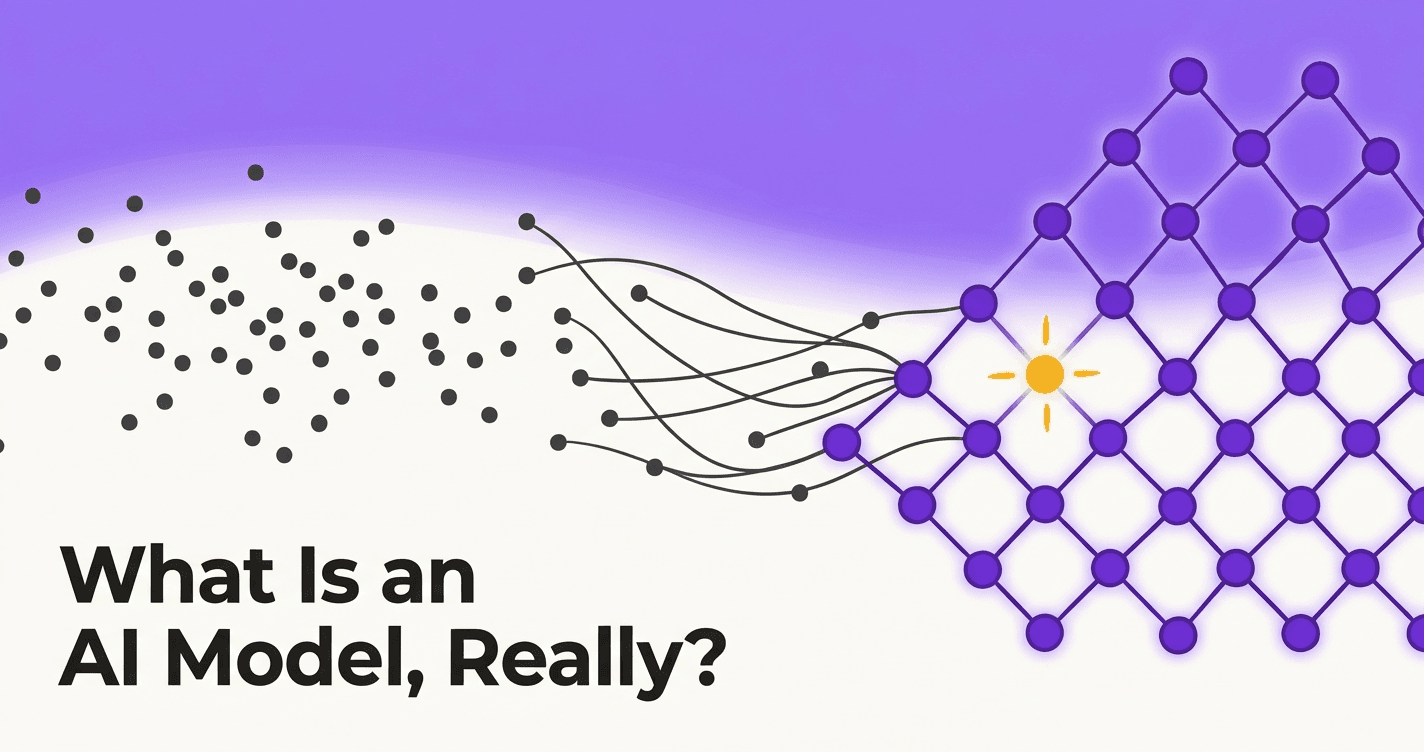
When engineers say "AI model," they do not mean a miniature version of something, or a mannequin, or a brain inside a chip. They mean a system that has been trained to spot patterns in data and use those patterns to make a guess.
That is the whole thing. A pattern-spotter trained on examples.
A model isn't a brain or a program — it's a pattern-spotter trained on examples.
The word "program" is the part that trips people up. Most software runs on instructions: if the user presses this button, show that screen. An AI model is different. Nobody sat down and wrote rules for it. Instead, someone fed it enormous amounts of examples — millions of photos, sentences, clicks, sounds — and let it find the regularities. What comes out the other side is something that can make useful predictions. But it does not "know" things the way you know your address. It calculates probabilities.
Three Things You Already Use Every Day
Netflix recommendations. When Netflix suggests a film you actually want to watch, that is a model at work. Netflix estimates that roughly 80% of what people watch on the platform comes from its recommendation system — not from search. The model was not programmed with rules like "if someone watches a thriller, show another thriller." It looked at the behavior of millions of viewers, found patterns too subtle for a human to articulate, and learned which suggestions lead to longer watch sessions.
Photo filters that identify faces. When your phone draws a box around a face in a photo, a model is running. It was trained on millions of labeled images — this is a face, this is not — until it could classify new images it had never seen. No human wrote down the rules for what makes a face a face. The model extracted them from examples.
Voice assistants. When you ask a speaker to play a song and it plays the right one, a model converted your sound waves into words, then another model guessed what you wanted. Both steps involve learned pattern-matching, not a lookup table someone typed in.
The Most Important Word: Probability
This is the part parents most need to hold on to. A model's output is a probability estimate, not a fact. When you type a question into an AI assistant and it answers confidently, it is effectively reasoning: given everything it learned from training, this answer has the highest probability of being correct. That is useful. It is not the same as true.
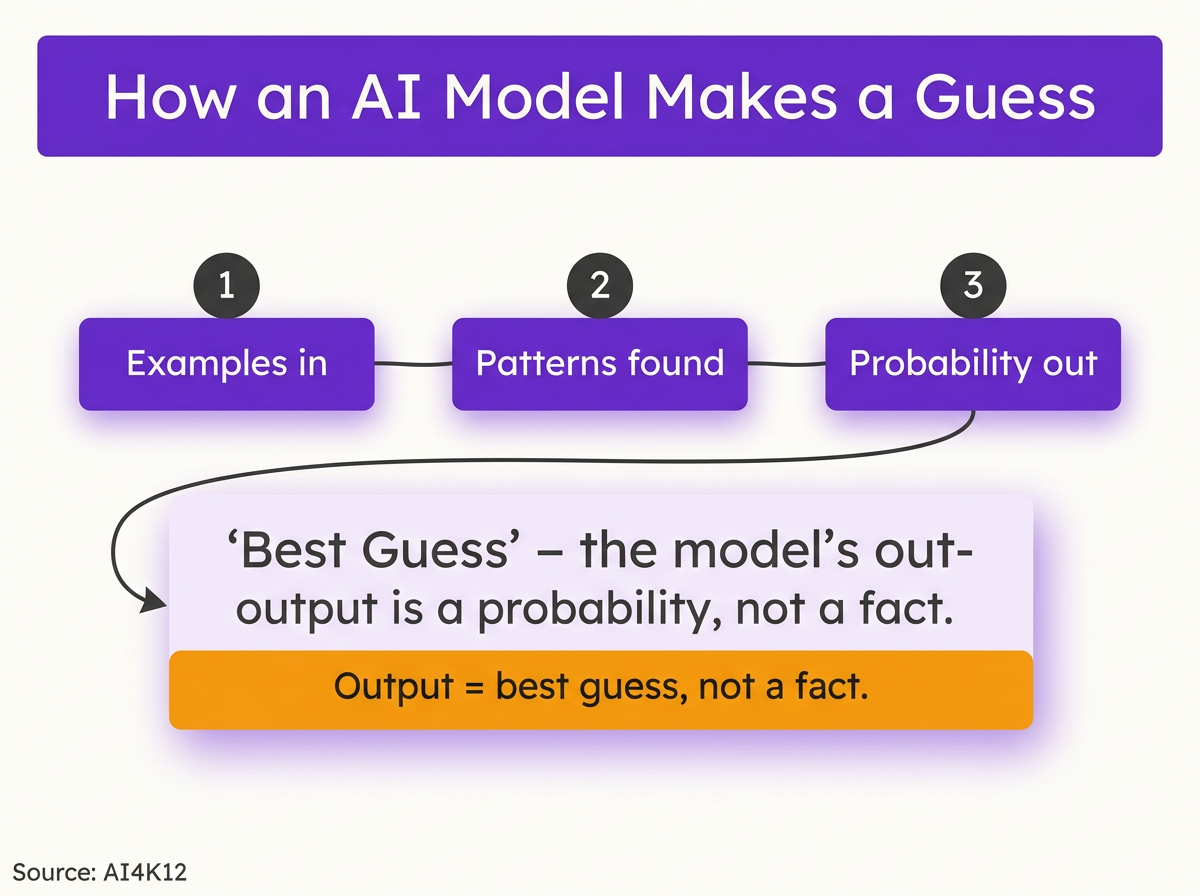
The AI4K12 initiative — a joint effort by leading computer science education associations that established the national guidelines for teaching AI in K-12 schools — frames this under its "Learning" big idea: computers learn from data, and that learning is inherently probabilistic. Understanding that distinction — confident-sounding versus actually verified — is arguably the single most important piece of AI literacy a child (or adult) can carry through life.
The UNESCO AI Competency Framework for Students, released in 2024, places this kind of foundational understanding under its "AI techniques and applications" dimension — one of four core competency areas for learners globally. Canada's own AI Literacy Framework for Elementary and Secondary Education anchors a similar idea in data literacy: before a learner evaluates an AI output, they need to understand what kind of thing that output is.
Why This Matters More Than It Sounds
Children who grow up not knowing this will treat confident AI outputs the way earlier generations treated printed text — as authoritative by default. That is how misinformation spreads without bad intent. A child who understands that a model is a probability machine will naturally ask: what was this trained on? How recent? Is this the kind of question a pattern-spotter can actually answer?
Those are not advanced questions. They are exactly the right questions for a ten-year-old.
What to Tell Your Child Tonight
You do not need a computer science degree to explain this. Try something like: an AI model is like a really fast guesser that learned from millions of examples. It doesn't actually know anything — it figures out what answer is probably right based on patterns it found. That's why it can be confident and wrong at the same time.
That sentence covers the conceptual ground that educators, curriculum frameworks, and AI researchers agree is foundational. It also gives your child a natural skepticism to carry forward.
At Digital Codi, this is precisely where the Foundations stream starts — with the mental model before the mechanics. Children aged 8–12 who build this understanding first are better placed to evaluate, judge, and create with AI rather than simply use it. The platform is designed to align with AI4K12, UNESCO, and national frameworks in both India and Canada, which all treat this conceptual fluency as the prerequisite for everything that follows.
Sources Cited
- AI4K12 — retrieved 2026-05-31
- UNESCO AI Competency Framework for Students — retrieved 2026-05-31
- Netflix ML Recommendation System — BrainForge AI — retrieved 2026-05-31
- Canada AI Literacy Framework — Digital Moment — retrieved 2026-05-31