
The Five Big Ideas, Explained at the Dinner Table
The whole shape of AI in five plain concepts.
At some point someone at the table asks what AI actually is — and most of us can name symptoms, not the thing itself. There is a map: the AI4K12 Five Big Ideas, in plain dinner-table language.
It happens at some point in most households. Someone — a parent, a grandparent, a sibling doing homework — asks what AI actually is. Not ChatGPT specifically. Not whether robots will take jobs. Just: what is the thing, underneath all the noise?
Most people pause. They can describe symptoms — AI writes text, recognises faces, recommends videos — but they can't name the underlying ideas. They have fragments, not a map.
There is a map. The AI4K12 initiative — jointly sponsored by the Association for the Advancement of Artificial Intelligence (AAAI) and the Computer Science Teachers Association (CSTA) — spent years distilling AI into five concepts that a non-specialist can hold in their head. They call it the Five Big Ideas in AI. The poster has been translated into more than a dozen languages. That breadth is not an accident — the ideas are genuinely portable.
Here they are, one at a time, in plain dinner-table language.
Big Idea 1: Perception
AI perceives the world through sensors and data, the same way humans perceive it through their senses.
A phone camera does not "see" a cat the way you do. It receives a grid of numbers — pixel brightness values — and pattern-matches those numbers against prior examples. That process of translating raw input into something meaningful is Perception. Every AI system working with images, sound, text, or sensor readings starts here.
One plain line: AI reads the world as numbers, then makes sense of the numbers.
Big Idea 2: Representation and Reasoning
AI stores knowledge in structured ways and uses that structure to draw conclusions.
Think of a knowledge graph — a web of facts like "Paris is the capital of France" and "France is in Europe" — that lets a system infer "Paris is in Europe" without being told. That combination of how knowledge is stored and how logic is applied is what this idea covers. It underpins every AI that answers questions, plays chess, or helps narrow a diagnosis.
One plain line: AI holds a model of the world in its memory and reasons from that model.
Big Idea 3: Learning
AI improves by finding patterns in data — it is not explicitly programmed with every answer.
This is the one most people have heard of, but often misunderstand. The system is not given rules for recognising a spam email. It is shown thousands of spam emails and thousands of legitimate ones, and it discovers the distinguishing patterns on its own. That is Learning. The quality of what an AI learns depends heavily on the quality of the data it trains on — a point that matters enormously when that data reflects human biases.
One plain line: AI learns from examples, not from a list of hand-written rules.
Big Idea 4: Natural Interaction
AI understands and generates language, speech, gesture, and context — the full texture of human communication.
When you ask a voice assistant to set a timer, several layers of AI work in concert: recognising your spoken words, parsing intent, retrieving the relevant action, and responding in natural speech. Natural Interaction covers how AI bridges the gap between the precise, formal language of machines and the messy, contextual way humans actually talk. Getting this right is one of the hardest problems in the field.
One plain line: AI bridges the gap between machine precision and the messy, contextual way humans actually talk.
Big Idea 5: Societal Impact
AI changes how people live, work, create, and relate to one another — and those changes carry ethical weight.
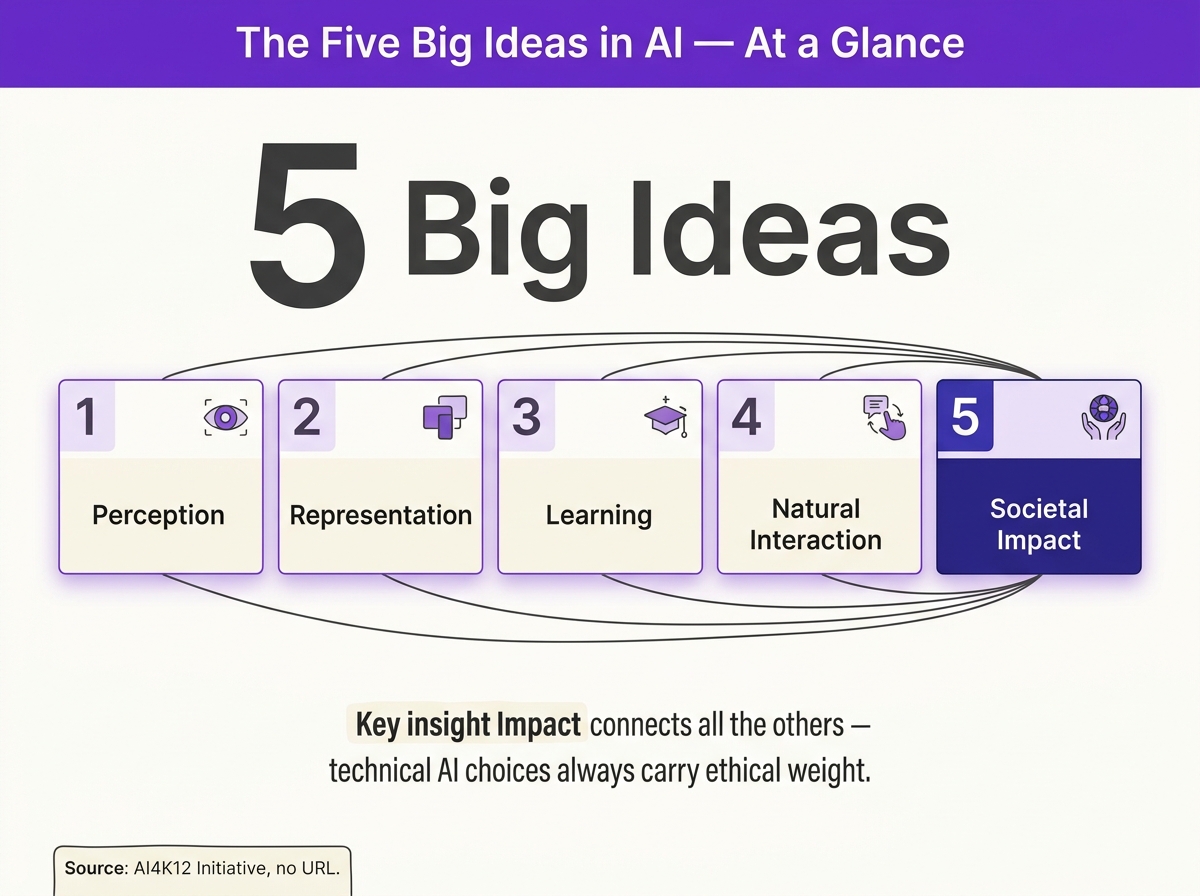
The AI4K12 framework poster places Societal Impact at the centre, surrounded by the other four ideas. That design choice is deliberate. The technical ideas do not operate in a vacuum. Decisions about what an AI system learns, what it perceives, and how it interacts all have consequences — for fairness, for privacy, for who gets access and who does not. Societal Impact is not an add-on ethics chapter; it is the lens through which the other four ideas are evaluated.
One plain line: AI's technical choices shape society — which makes those choices everyone's business.
Five ideas. Learn these and you understand the shape of AI.
Why five ideas — and why these five?
A framework with hundreds of competencies is useful for curriculum designers. It is not useful at a dinner table. The AI4K12 team made an editorial judgment: five ideas are enough to give any adult a mental skeleton for the subject. Not expertise. Not a textbook. A skeleton.
The UNESCO AI competency framework for students goes deeper — 12 competencies across 4 dimensions, spanning three levels of progression (Understand, Apply, Create). UNESCO builds the scaffolding for systematic school-level learning; the Five Big Ideas give families the vocabulary to engage with that scaffolding at home. Neither replaces the other.
What to do with this at home and in school
For a parent, the five ideas are a conversation starter. Not a curriculum. If a child comes home talking about how a recommendation algorithm works, that is Big Idea 3 — Learning. If the discussion turns to whether facial recognition should be used in schools, that is Big Idea 1 meets Big Idea 5. Having names for the ideas makes those conversations easier to navigate and less likely to dissolve into vague anxiety.
For a school leader, the five ideas are a shared reference point. When evaluating AI literacy programmes, asking "does this cover all five?" is a reasonable baseline check. A programme that covers only Learning and Natural Interaction — the flashiest two — and ignores Representation and Societal Impact is leaving important ground uncovered.
Digital Codi's curriculum is designed to align with both the AI4K12 Five Big Ideas and the UNESCO student framework, so learners aged 8–12 move through all five domains across the programme's seven learning streams — from Foundations to Ethics to the Builders Lab — rather than circling the same one or two ideas repeatedly.
Starting from the shape
Most AI conversations in the media start from a product, a headline, or a fear. That is not a bad place to start, but it is a hard place to stay oriented from. The Five Big Ideas offer something different: a fixed map of the territory that does not change every six months when a new model is released.
Perception. Representation and Reasoning. Learning. Natural Interaction. Societal Impact.
Teach these five to a ten-year-old, and they will have a better framework for evaluating AI news than most adults who consume it daily. That is not a small thing.
Sources Cited
- AI4K12 — Artificial Intelligence Thinking in K-12 — retrieved 2026-05-31
- UNESCO AI Competency Framework for Students — retrieved 2026-05-31