
How AI Talks: ChatGPT Is a Word-Probability Engine
Fluent, confident, and sometimes completely invented.
Ask ChatGPT who invented the telephone and it nails it. Ask about an obscure figure and it invents a biography — same tone, same certainty. That's not a bug; it's a next-word guesser doing exactly what it was built to do.
Your child asks ChatGPT who invented the telephone. It answers immediately — confident, fluent, citing Alexander Graham Bell. Sounds right. But then they ask about a minor historical figure, and ChatGPT invents a biography from scratch. Same tone. Same certainty. Same complete wrongness.
That moment of confusion is not a bug to be patched. It is the direct result of how the tool actually works. Once you understand what an AI model actually is, the behaviour stops being baffling and starts being predictable.
A Game You Already Know
Start with a simple exercise. Say these words out loud, then pause:
"I'm so hungry I could eat a ..."
You probably said "horse." Or at least you had one word ready without thinking. You didn't reason through the sentence. You pattern-matched. Decades of hearing that phrase produced an instant, high-confidence prediction.
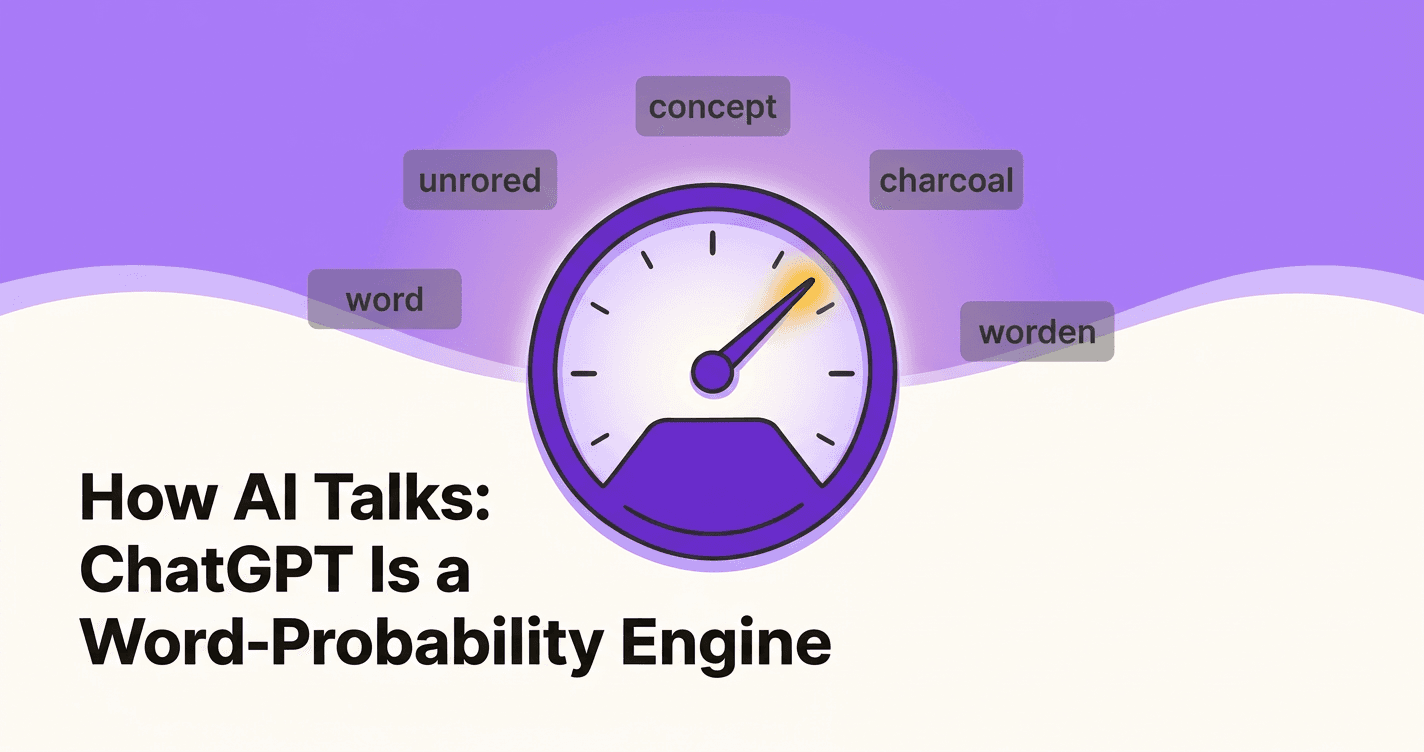
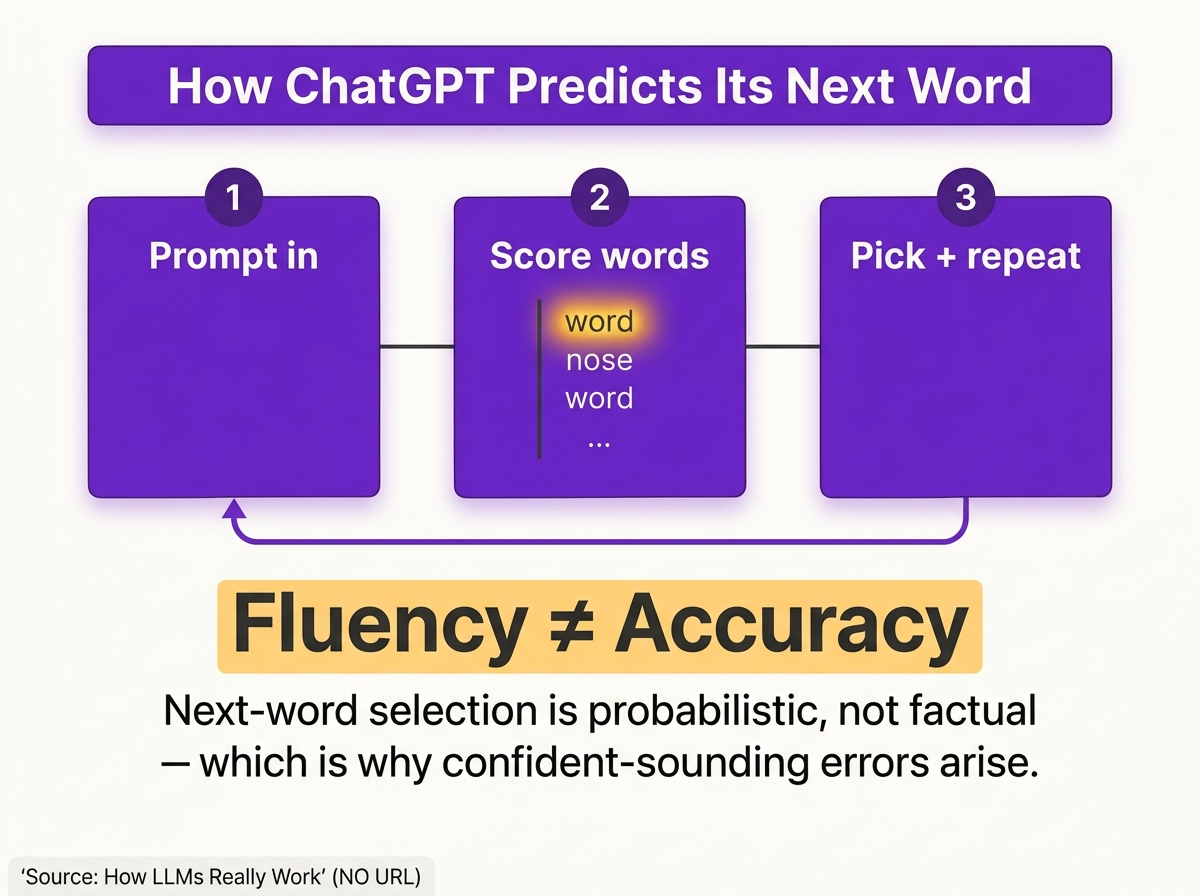
ChatGPT runs the same process — at enormous scale. It has processed hundreds of billions of words across the internet, books, articles, and code. Given any fragment of text, it calculates: what word is statistically most likely to come next? Then it picks one, adds it, and repeats. One word at a time, thousands of times per second, until your answer looks complete.
That is the entire engine. Not reasoning. Not understanding. Not looking things up. Predicting the next word based on patterns learned from text.
It's not thinking — it's guessing the next word, very well.
Why the Answer Sounds So Convincing
The system is trained on text written by humans who were, for the most part, making grammatical sense. So its outputs are grammatically coherent, appropriately hedged where humans hedge, and confident-sounding where humans are confident. The form is familiar. That familiarity reads as reliability — and that is the trap.
AI4K12, the national K-12 AI education framework jointly sponsored by the Association for the Advancement of Artificial Intelligence (AAAI) and the Computer Science Teachers Association (CSTA), includes "Natural Interaction" as one of its Five Big Ideas precisely because this is so easy to misread. The idea is not that AI understands you; it is that AI has learned to respond in ways that mimic understanding. The surface fluency is real. The comprehension beneath it is not.
This distinction matters enormously. ChatGPT was released to the public on November 30, 2022 and reached 100 million monthly active users by January 2023 — the fastest a consumer app had ever scaled to that milestone. Hundreds of millions of people began treating its outputs as authoritative almost immediately. Most of them did not know they were talking to a word-probability engine.
Where Confident Wrongness Comes From
Consider what happens when ChatGPT is asked about something rare, obscure, or outside its training data. The probability engine still runs. It still produces a plausible-sounding next word, then the next. There is no internal alarm that fires when the model is operating beyond reliable ground. The output is just as grammatical, just as fluent, just as confident.
This is what researchers call hallucination — the model generating factually incorrect content because it is optimised for fluent, conversational output, not for accuracy. A chatbot asked about a little-known historical figure may produce a name, a birthdate, a legacy — all invented, none flagged as uncertain. Not because it is lying. Because it is doing exactly what it was designed to do: predict the next most-likely word.
The mechanism that makes it so useful (producing coherent, contextually appropriate text) is the same mechanism that makes it unreliable on facts. These are not separate problems. They are the same feature.
What This Changes for Your Child
Your child has good instincts about people. Fluency reads as knowledge; confidence reads as expertise. Those instincts are healthy in human relationships. Applied to a chatbot, they backfire.
The corrective is not to stop using these tools. It is to hold the right mental model. A word-probability engine is genuinely useful for brainstorming, summarising ideas, drafting text, exploring possibilities, and explaining concepts in plain language. It is not a reliable source of factual lookup.
A child who understands this uses the tool differently. They verify claims that matter. They notice when something sounds suspiciously neat. They ask follow-up questions rather than accepting the first response.
This habit — evaluating AI output rather than accepting it — is exactly what AI literacy researchers mean by critical evaluation. AI4K12 puts it this way in its Representation and Reasoning Big Idea: AI systems represent knowledge in ways that can be incomplete or biased. Understanding the mechanism is the first step toward that calm, everyday critical stance.
The Practical Move
Next time your child brings you something ChatGPT produced, try asking one question together: "What would we need to check to know if this is true?" Not "is ChatGPT wrong?" — sometimes it isn't. Just: what would verify it? That single habit, practiced consistently, is worth more than any filter or rule.
If you want that habit to deepen into real fluency, Digital Codi's Language and NLP stream (S5) is built around exactly this mental model. The learning path introduces children aged 8–12 to how language AI actually works — from everyday word patterns to the reasons responses sometimes miss the mark — so they develop mechanical intuition alongside critical evaluation. One of Digital Codi's five core capacities is critical evaluation: the ability to assess AI output rather than accept it at home or in the classroom. The platform is designed to align with UNESCO AI literacy guidelines and the AI4K12 approach, with the goal of producing competence, not just caution.
Understanding what ChatGPT is — a very sophisticated, very fast, next-word predictor — is the first step toward using it well.
Sources Cited
- Wikipedia — ChatGPT — retrieved 2026-05-31
- Time — Why ChatGPT Is the Fastest Growing Web Platform Ever — retrieved 2026-05-31
- How Large Language Models Really Work: Next-Token Prediction at the Core — retrieved 2026-05-31
- AI4K12 — Artificial Intelligence Thinking in K-12 — retrieved 2026-05-31
- Hallucination (artificial intelligence) — Wikipedia — retrieved 2026-05-31